Download
1 / 4
40 likes | 190 Vues
This study presents a novel approach to extend compact models for Multi-Gate MOSFETs to high-frequency operations using an active line segmentation method. By dividing the channel into elementary sections, we develop an analytical model that incorporates microscopic diffusion and gate shot noise sources. Our model provides explicit expressions for local small-signal parameters, allowing comprehensive analysis of frequency noise behavior and extrinsic noise parameters as functions of gate length. We also compare currents and correlation coefficients from this method with traditional models.

E N D
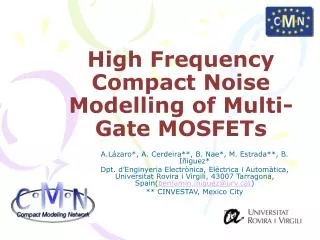
High Frequency Compact Noise Modelling of Multi-Gate MOSFETs A.Lázaro*, A. Cerdeira**, B. Nae*, M. Estrada**, B. Iñiguez* Dpt. d’Enginyeria Electrònica, Elèctrica i Automàtica, Universitat Rovira i Virgili, 43007 Tarragona, Spain(benjamin.iniguez@urv.cat) ** CINVESTAV, Mexico City
Segmentation method • We use the active line approach to extend the compact model to high frequency operation. It is based on splitting the channel into a number of elementary sections • Our quasi-static small-signal equivalent circuit, to which we add additional microscopic diffusion and gate shot noise sources, is applied to each section • Our charge control model allows to obtain analytical expressions of the local small-signal parameters in each segment
Segmentation Method Frequency noise behaviour of FminWfin=10 nm, Hfin=30 nm, tox=1.5 nm, tbox=50 nm, 100 fingers,VGS−VTH=0.5 V, VDS=1 V at 10 GHz Extrinsic noise parameters as function of gate length for FinFET Wfin=10 nm, Hfin=30 nm, tox=1.5 nm, tbox=50 nm, 100 fingers,VGS−VTH=0.5 V, VDS=1 V at 10 GHz.
Analytical explicit model Single-piece compact expressions to model the drain, gate current noise spectrum densities and their correlations were derived for for DG MOSFETs Comparison of current noise densities and imaginary part of correlation coefficient as function of gate voltage calculated with the segmentation method (●) and the singlepiece model (—) for a DG MOSFET with L=1 μm, tox=2 nm, ts=34 nm, VDS=2V, f=1 GHz).