Understanding SI Units and Conversions in Measurement
This document explores the fundamentals of SI units, detailing the two parts of measurement: the number and the scale (unit). It covers important temperature scales including Celsius and Kelvin, along with conversion formulas between Celsius and Fahrenheit. Additionally, it introduces commonly used SI prefixes and provides examples of metric conversions, focusing on grams, liters, and milliliters. Ideal for students seeking to grasp the principles of measurement, this guide assists with practical applications and conversions in chemistry and physics.

Understanding SI Units and Conversions in Measurement
E N D
Presentation Transcript
Unit 1-3 SI units • Do now: read chapter 1.6
How much does it cost? • UNITS MATTER!!
The Nature of Measurement A Measurement is a quantitative observation consisting of TWO parts • Part 1-number • Part 2-scale (unit) Examples: 20grams 6.63 x 10⁻³⁴seconds
The three major temperature scales. TK = TC + 273.15 TC = TK – 273.15
Temperature scales • Celsius scale • based on freezing and boiling points of water (0 oC – 100 oC) • Kelvin scale • based on absolute zero (0 K) temperature at which particles are at lowest possible energy • NO negative numbers
K = oC + 273 oC = K – 273
Converting Between Celsius & Fahrenheit • TC = (TF – 32)X 5/9 • TF = TC x 9/5 + 32 • You don’t need to memorize the conversion between TCand TF
mega- tera- hecto- deka- giga- kilo- M G k h T da 1012 106 102 101 109 103 deci- d 10-1 centi- c 10-2 milli- m 10-3 micro- 10-6 BASE UNIT --- 100 pico- nano- p n 10-9 10-12 SI Prefix Conversions Prefix Symbol Factor Decimal move left Decimal move right
Prefix conversion g m L 103 10-1 10-2 10-3 102 101 kilo hecto deka Base unit deci centi milli Conversions between prefixes are merely a matter of moving a decimal point. The “base unit” means the you have a quantity (grams, meters, Liters, etc without a prefix.
Metric Conversions g m L 103 10-1 10-2 10-3 102 101 kilo hecto deka Base unit deci centi milli 1 2 3 18 L 18 liters = 18 000 milliliters Example #1: Convert 18 liters to milliliters
Metric Conversions g m L 103 10-1 10-2 10-3 102 101 kilo hecto deka Base unit deci centi milli 3 2 1 450 mg = 0.450 g 450 mg Example #2: Convert 450 milligrams to grams
Metric Conversions g m L 103 10-1 10-2 10-3 102 101 kilo hecto deka Base unit deci centi milli 2 3 1 4 5 6 20 kg 20 kg = 20 000 000 mg Example #3: Convert 20 kilograms to milligrams
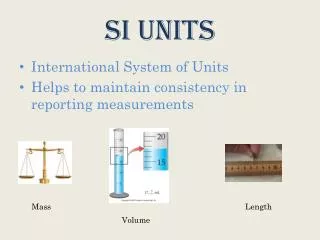
Derived SI units • Volume= (length)3 • SI unit of V: m3 • Commonly used units of V: • Liter(L)= dm3 • Milliliter(ml)=cm3
SI Prefix Conversions-concept check a. cm to m b. m3 to L c. ns to s d. kg to g
SI Prefix Conversions-concept check 20 cm = ______________ m 2) 0.032 L = ______________ mL 3) 45 m = ______________ m
Homework • Handout • Due next class.