Enhancing Recycling at Penn State: A Sustainable Approach to Waste Management
This project addresses the need for improved waste management and recycling at Penn State University Park. By implementing innovative solutions like dividable trash cans and utilizing paper wrapping instead of aluminum, we aim to increase waste diversion from landfills. Key factors include enhancing public awareness, maintaining economic viability, and improving overall quality of life on campus. Our goal is to boost aluminum recycling, reduce landfill waste by up to 1,791 tons, and attain a waste diversion rate of 75%. Sustainable practices that benefit the environment are critical for campus improvement.

Enhancing Recycling at Penn State: A Sustainable Approach to Waste Management
E N D
Presentation Transcript
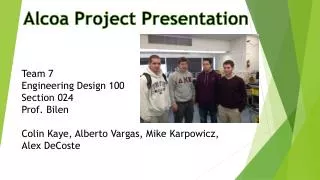
ALCOA Project Team 3: Matt Kelly, Brett Yerg, Michael cecchini, Mackenzie goddard
Summary • The initial ideas • Our choice and its 5 factors • How it will be implemented on campus • Its impact on Penn State University Park • Its benefits
Initial Ideas • Pie Dish • Use thicker aluminum • Split Trash Can • Half waste & half recyclable • Paper Wrappers • Paper wrapping instead of aluminum wrapping • Bottles Over Cans • Use more plastic bottles as to more aluminum cans
The 5 Factors • Human Factors • People become more conscientious of recycling (Aluminum) • Innovative • Split trash cans are rarely used in private settings • Quality of Life • Quality of life increases with less waste in landfills • Implementation • Personal trash cans replaced within a week • Economic Viability • Will increase aluminum recycling while maintaining same cost as before
What Will Change Public Personal
Present Circumstances at UP Public • Personal • 6500 waste bins • 0 recyclable bins • 4.3 lbs. of waste a day • 1.5 lbs. of recycling a day • 785 waste bins • 4715 recycling/compost bins • 64% waste diversion • 36% of recycling goes to landfill • 15,000 tons of solid waste in 2012 Sustainability Institute Communication Team
Waste Diversion • The prevention of recyclable objects being thrown away • By adding campus wide dividable trash cans, Penn State can increase waste diversion by 1,791 tons • This increase will cause an overall waste diversion of 75% • 11% increase
The Impact of the Design Weight in pounds (lbs.)
Aluminum Impact • 250 cans per year • 84 cans thrown away with rate of 64% • 63 cans thrown away with rate of 75% • 20 x 13,000 = 260,000 cans! • Saves time, money, and energy
Simple and Effective • Implementation is easy • Has a great economic viability • Inexpensive • Increases quality of life • Can produce great benefits • Reduce waste at landfills • Reduces energy and resources required to make new cans
Works Cited • http://www3.imperial.ac.uk/facilitiesmanagement/softservices/wasteandrecycling/recycling%20faq/whyshouldwerecycle • http://earth911.com/recycling/facts-about-aluminum-recycling/ • http://www.adaweb.net/SolidWasteManagement/WasteDiversionRecycling.aspx • http://www.aluminum.org/Content/NavigationMenu/TheIndustry/Recycling/Whyrecycle/ • Sustainability Institute Communications Team