A Subbasin-Based Framework for Simulating Streamflow in Major US River Basins
This study presents a subbasin-based hydrologic modeling framework utilizing the Community Land Model (CLM) coupled with the Model for Scale-Adaptive River Transport (MOSART). It aims to demonstrate the scalability advantages of the subbasin approach compared to traditional grid-based methods in simulating streamflow. By conducting simulations across various spatial resolutions, the research reveals significant improvements in modeling peak and mean streamflow within U.S. river basins characterized by different climatic conditions. The findings underscore the potential of subbasin frameworks for enhancing hydrological predictions.

A Subbasin-Based Framework for Simulating Streamflow in Major US River Basins
E N D
Presentation Transcript
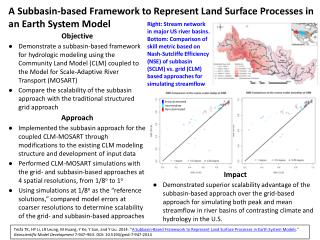
A Subbasin-based Framework to Represent Land Surface Processes in an Earth System Model Right: Stream network in major US river basins. Bottom: Comparison of skill metric based on Nash-Sutcliffe Efficiency (NSE) of subbasin (SCLM) vs. grid (CLM) based approaches for simulating streamflow • Objective • Demonstrate a subbasin-based framework for hydrologic modeling using the Community Land Model (CLM) coupled to the Model for Scale-Adaptive River Transport (MOSART) • Compare the scalability of the subbasin approach with the traditional structured grid approach • Approach • Implemented the subbasin approach for the coupled CLM-MOSART through modifications to the existing CLM modeling structure and development of input data • Performed CLM-MOSART simulations with the grid- and subbasin-based approaches at 4 spatial resolutions, from 1/8o to 1o • Using simulations at 1/8o as the “reference solutions,” compared model errors at coarser resolutions to determine scalability of the grid- and subbasin-based approaches Snow dominated Intermediate Rain dominated • Impact • Demonstrated superior scalability advantage of the subbasin-based approach over the grid-based approach for simulating both peak and mean streamflow in river basins of contrasting climate and hydrology in the U.S. Tesfa TK, HY Li, LR Leung, M Huang, Y Ke, Y Sun, and Y Liu. 2014. “A Subbasin-Based Framework to Represent Land Surface Processes in Earth System Models.” Geoscientific Model Development 7:947–963. DOI: 10.5194/gmd-7-947-2014