
Atomic Structure
E N D
Presentation Transcript
Atomic Structure Modern Atomic Theory
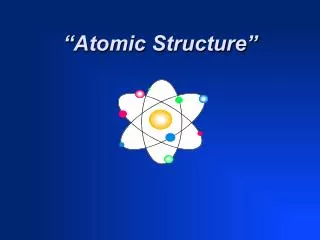
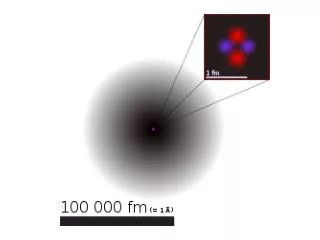
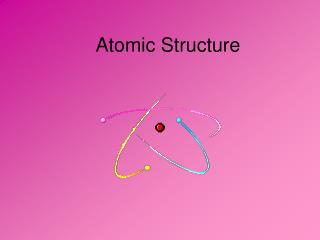
Modern Atomic Theory • The atom consists of positive protons, negative electrons, and neutral neutrons. • Protons and neutrons are located in the nucleus of the atom, which is small and massive. • Electrons are located outside of the nucleus, which creates the volume of the atom.
Subatomic particles Actual mass (g) Relative mass (amu) Name Symbol Charge Electron e- 9.11 x 10⁻²⁸ -1 1/1840 ≈ 0 Proton p+ 1 1.67 x 10⁻²⁴ +1 0 Neutron n0 1 1.67 x 10⁻²⁴ amu = atomic mass unit
Atomic Number • Henry Moseley discovered that each element has a unique positive charge. • Atomic Number or Z • Number of Protons • For neutral atoms # protons = # of electrons • How many protons and electrons are in Si? • 14 p and 14 e • What element contains 8 protons? • oxygen
Ions • Most atoms are not neutral. • An ion forms when an atom loses or gains electrons. • Lose electrons = positive charge • Gain electrons = negative charge • Ion charge is written as a superscript. • Charge = # protons - # electrons • What is the element with 16 protons and 18 electrons? • S-2 • What is the element with 20 protons and 18 electrons? • Ca+2
Atomic Mass • Atomic mass or A is the number of protons and neutrons in an atom. • Atomic Mass Unit or amu • based on carbon-12, exactly 12 amu • We always round atomic mass to the nearest whole number. • Why? • Atomic mass is the weighted average of all of isotopes for that element based on abundance.
Mass number X A Z Element symbol Atomic number Isotopic Notation • We write symbols for elements as follows:
1 1 2 1 3 1 H H H Isotopes • Atoms with the same number of protons different number of neutrons, therefore different atomic masses.
Naming Isotopes • We can also put the mass number after the name of the element. • carbon- 12 • carbon -14 • uranium-235
Calculating averages • Multiply the atomic mass of each isotope by it’s abundance (expressed as a decimal), then add the results. • Calculate the atomic mass of copper if copper has two isotopes. 69.1% has a mass of 62.93 amu and the rest has a mass of 64.93 amu. • 62.93 amu x .691 = 43.5 amu 64.93 amu x .309 = 20.1 amu Total = 43.5 + 20.1 = 63.6 amu
Atomic Mass 23 amu • What is the atomic mass of Na? • What is the atomic number of Na? • Write this in isotopic notation: • To find the neutrons subtract the two numbers. 11 amu 23 Na 11 23 -11 = 12 amu
Symbols • Find the • number of protons • number of neutrons • number of electrons • Atomic number • Mass Number 35 p 45 n 80 Br 35 e 35 35 80 amu
Symbols • Find the • number of protons • number of neutrons • number of electrons • Atomic number • Mass Number 35 p 45 n 80 -1 Br 36 e 35 35 80 amu
Symbols • if an element has an atomic number of 34 and a mass number of 78 what is the • number of protons • number of neutrons • number of electrons • Complete symbol 34 p 44 n 34 e 78 Se 34
Symbols • if an element has 91 protons and 140 neutrons what is the • Atomic number • Mass number • number of electrons • Complete symbol 91 231 amu 91 231 Pa 91
Mass number H 1 1 Element symbol Atomic number Summary Element charge +1
Symbols • Find the • number of protons • number of neutrons • number of electrons • Atomic number • Mass Number • Is this an ion? • Is this an isotope? 56 p 79 n 135 +2 Ba 54 e 56 56 135 amu Yes Yes