Download
1 / 21
210 likes | 334 Vues
Explore the concept of functions that take no arguments in C++ programming. This guide showcases the definition and invocation of such functions, illustrated with practical examples. Learn about simple function calls, printing messages, and demonstrating scope through reference and value parameters. Gain insights into modifying values and utilizing local, static, and global variables effectively. Ideal for beginners looking to understand the essentials of function implementation in C++. ###

E N D
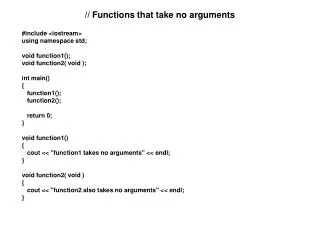
// Functions that take no arguments #include <iostream> using namespace std; void function1(); void function2( void ); int main() { function1(); function2(); return 0; } void function1() { cout << "function1 takes no arguments" << endl; } void function2( void ) { cout << "function2 also takes no arguments" << endl; }
Example #include <iostream> using namespace std; void printStars(); int main() { printStars(); //Line 1 cout << "********** Annual ***********" << endl; //Line 2 printStars(); //Line 3 cout << "******* Spring Sale **********" << endl; //Line 4 printStars(); //Line 5 return 0; } void printStars() { cout << "******************************" << endl; cout << "******************************" << endl; }
solution #include<iostream> using namespace std; void square( int m ); // function prototype //it can be int square( int ); int main() { for ( int x = 1; x <= 10; x++ ) square( x ) ; //calling statement x is actual parameter cout << endl; return 0; } // Function definition void square( int y ) // Heading y is Formal Parameter { return y * y; // The return Statement }
#include<iostream> using namespace std; void square( int m ); // function prototype //it can be int square( int ); int main() { for ( int x = 1; x <= 10; x++ ) square( x ) ; //calling statement x is actual parameter cout << endl; return 0; } // Function definition void square( int y ) // Heading y is Formal Parameter { cout<< y * y<<endl; // The return Statement }
Modify (Value parameters) #include<iostream> using namespace std; void modify( int m ); // function prototype int main() { int x; x=7; cout<<"x befor calling modify function = "<<x<<endl; modify( x ) ; //calling statement x is actual parameter cout<<"x After calling modify function = "<<x<<endl; cout << endl; return 0; } // Function definition void modify( int y ) // Heading y is Formal Parameter { y=y+10; // The return Statement cout<<"y inside modify function = "<<y<<endl; }
Reference parameters #include<iostream> using namespace std; void modify( int &m ); // function prototype int main() { int x; x=7; cout<<"x befor calling modify function = "<<x<<endl; modify( x ) ; //calling statement x is actual parameter cout<<"x After calling modify function = "<<x<<endl; cout << endl; return 0; } // Function definition void modify( int &y ) // Heading y is Formal Parameter { y=y+10; // The return Statement cout<<"y inside modify function = "<<y<<endl; }
Reference // References must be initialized #include <iostream> using namespace std; int main() { int x = 3, &y = x; // y is now an alias for x cout << "x = " << x << endl << "y = " << y << endl; y = 7; cout << "x = " << x << endl << "y = " << y << endl; return 0; }
// A scoping example #include <iostream> using namespace std; void a( ); // function prototype void b( ); // function prototype void c( void ); // function prototype int x = 1; // global variable int main() { int x = 5; // local variable to main cout << "local x in outer scope of main is " << x << endl; { // start new scope int x = 7; cout << "local x in inner scope of main is " << x << endl; } // end new scope cout << "globel x in outer scope of main is " << ::x << endl; cout << "local x in outer scope of main is " << x << endl; cout<<"*************************************************"<<endl; a(); // a has automatic local x b(); // b has static local x c(); // c uses global x cout<<"*************************************************"<<endl; cout<<"Afetr second calling"<<endl; a(); // a reinitializes automatic local x b(); // static local x retains its previous value c(); // global x also retains its value cout <<endl<< "local x in main is " << x <<endl<< endl; return 0; } 5 7 1 5 5
25 25 in second call void a( ) { int x = 25; // initialized each time a is called cout << endl << "local x in a is " << x << " after entering a" << endl; } void b( ) { static int x = 50; // Static initialization only // first time b is called. cout << endl << "local static x is " << x << " on entering b" << endl; x=x+2; } void c( void ) { cout << endl << "global x is " << x << " on entering c" << endl; x *= 10; } 50 in first call 52 in Second call call 1 10 after second call
// Using overloaded functions // Using overloaded functions #include <iostream> using namespace std; int square( int x ); double square( double y ); int main() { cout << "The square of integer 7 is " << square( 7 )<<endl << "The square of double 7.5 is " << square( 7.5 ) << endl; return 0; } int square( int x ) { return x * x; } double square( double y ) { return y * y; }
// Using default arguments // Using default arguments #include <iostream> using namespace std; int boxVolume( int length = 1, int width = 1, int height = 1 ); int main() { cout << "The default box volume is: " << boxVolume() <<endl; cout<< "width 1 and height 1 is: " << boxVolume( 10 ) << endl; cout << "width 5 and height 1 is: " << boxVolume( 10, 5 ) << endl; cout << "width 5 and height 2 is: " << boxVolume( 10, 5, 2 ) << endl; return 0; } // Calculate the volume of a box int boxVolume( int length, int width, int height ) { return length * width * height; }