Flasher reconstruction at LBNL
180 likes | 210 Vues
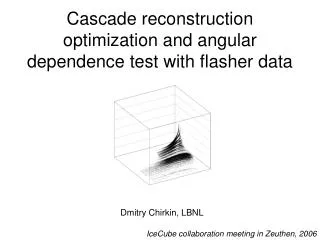
Explore flasher/cascade reconstruction methods for energy estimate and IceTop showers with the fat-reader module. Gain insights into Quantum efficiency and PMT area for energy reconstruction and intensity variations analysis. Implement advanced algorithms for track and cascade position in IceCube depths.


Flasher reconstruction at LBNL
E N D
Presentation Transcript
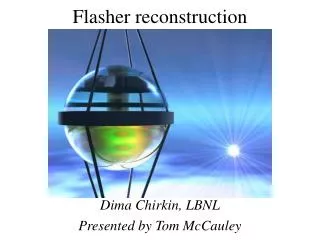
Flasher reconstruction at LBNL Dima Chirkin
muon track: flasher/cascade: t=t0+|z-z0|/c Residual time description
Scattering Absorption ice bubbles dust dust Ice description
Reconstruction in fat-reader • fat-reader contains a plug-in reconstruction module, which: • uses convoluted pandel description • uses multi-media propagation coefficients • relies on the Kurt’s 6-parameter ice model • has Klaus’s stability of the solution • parameterization is possible for bulk ice • reconstructs both tracks and showers/flashers • calculates an energy estimate • also reconstructs IceTop showers
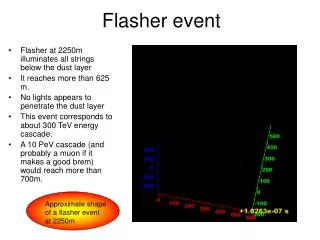
Flasher energy estimate Quantum efficiency = 0.24 PMT area = 492.10 cm2 Energy = 5.08 TeV Cascade: 1.37 105 photons/GeV
Conclusions • In-ice track and cascade position and energy reconstruction algorithms have been implemented in a module of the fat-reader. • Flasher position reconstruction works very well • Despite a very early state of the energy reconstruction, results are encouraging. Outlook • only rough optimization of the llh parameters was performed, need to refine. Kurt’s ice model has been extended to all IceCube depths, will need to rerun reconstruction with new tables • detailed measurement of scattering coefficients with the string • IceTray implementation and further improvements, e.g., multiple coincident event reconstruction (by Jon Aytac)