
SlideServe
Menu
Préférences
© SlideServe · v2026

BRAIN CONTROLLED ARTIFICIAL LEGS

tabib avatar
12 diapositives · 367 Views · Jan 25, 2013

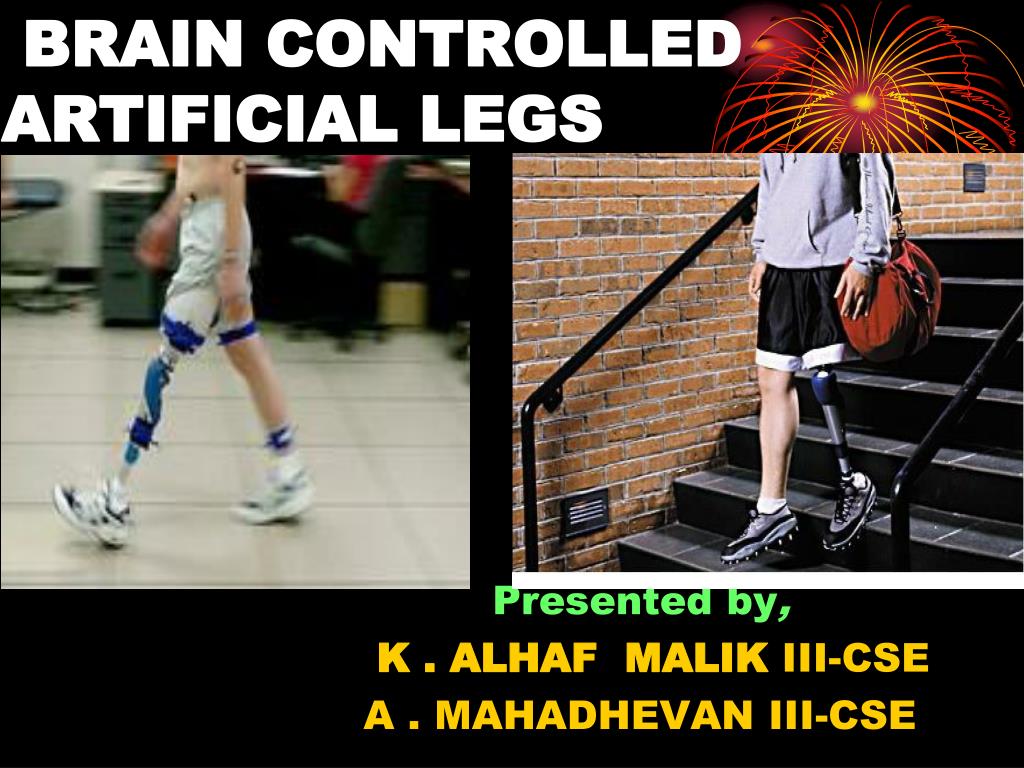
BRAIN CONTROLLED ARTIFICIAL LEGS. Presented by , K . ALHAF MALIK III-CSE A . MAHADHEVAN III-CSE. BCI. Brain computer interface.
BRAIN CONTROLLED ARTIFICIAL LEGS - slide 1
01 / 12BRAIN CONTROLLED ARTIFICIAL LEGS
1 / 17

Télécharger la présentation

BRAIN CONTROLLED ARTIFICIAL LEGS
Une image / un lien ci-dessous est fourni (tel quel) pour télécharger la présentation

Politique de téléchargement : le contenu du site vous est fourni TEL QUEL pour votre information et votre usage personnel ; il ne peut être vendu, concédé sous licence ni partagé sur d’autres sites sans l’accord de son auteur.Le contenu vous est fourni TEL QUEL, pour votre information et votre usage personnel uniquement. Téléchargez la présentation en cliquant sur ce lien. Lors du téléchargement, si vous ne parvenez pas à télécharger une présentation, l’éditeur a peut-être supprimé le fichier de son serveur.Pendant le téléchargement, si vous ne parvenez pas à obtenir une présentation, le fichier a peut-être été supprimé par l’éditeur.

F I N

Plus de contenu associé

Transcription de la présentation
  1. BRAIN CONTROLLED ARTIFICIAL LEGS Presented by, K . ALHAF MALIK III-CSE A . MAHADHEVAN III-CSE

  2. BCI Brain computer interface. It is a direct communication path way between a human brain or animal brain and external device.

  3. BRAIN WAVES There are four categories Beta waves(15-40 c/sec) Alpha waves(9-14 c/sec) Theta waves(5-8c/sec) Delta waves(1.5-4c/sec)

  4. Functions of Block diagram

  5. ELECTRODE CAP It contains electrodes which are placed on the skull in an arrangement called 10-20 system. Main function of the electrode cap is to take the brain signals in the form of electrical signals

  6. AMPLIFIER Output signal from the electrode cap will be in the range of milli volt & microvolt Hence there is a need for amplification ADC • Output signals are analog in nature • So the signals are sent to ADC to convert the analog signals to the digital signals

  7. SIGNAL PROCESSOR Using the ouput signal from the a/d conv. Parameter extraction, pattern classification & pattern identification are done. Then the signal is fed to FFT unit for simplifying the calculations MICROCONTROLLER UNIT • It performs the robotic operations with the help of stepper motor • It will control the operations like walking, running etc.

  8. Appearance of artificial legs

  9. POWER SUPPLY It uses Li-ion battery It require to charge once in 2days The life time will be longer when compared to other batteries

  10. DIFF. BETWEEN NORMAL AND BRAIN CONTROLLED ARTIFICIAL LEGS

  11. conclusion The performance of the proposed system will be better than the existing artificial legs With the system life can be made easier for the differently abled persons

  12. QUERIES ?