
SlideServe
Menu
Préférences
© SlideServe · v2026

(0,0)

tacey avatar
11 diapositives · 295 Views · Aug 14, 2014

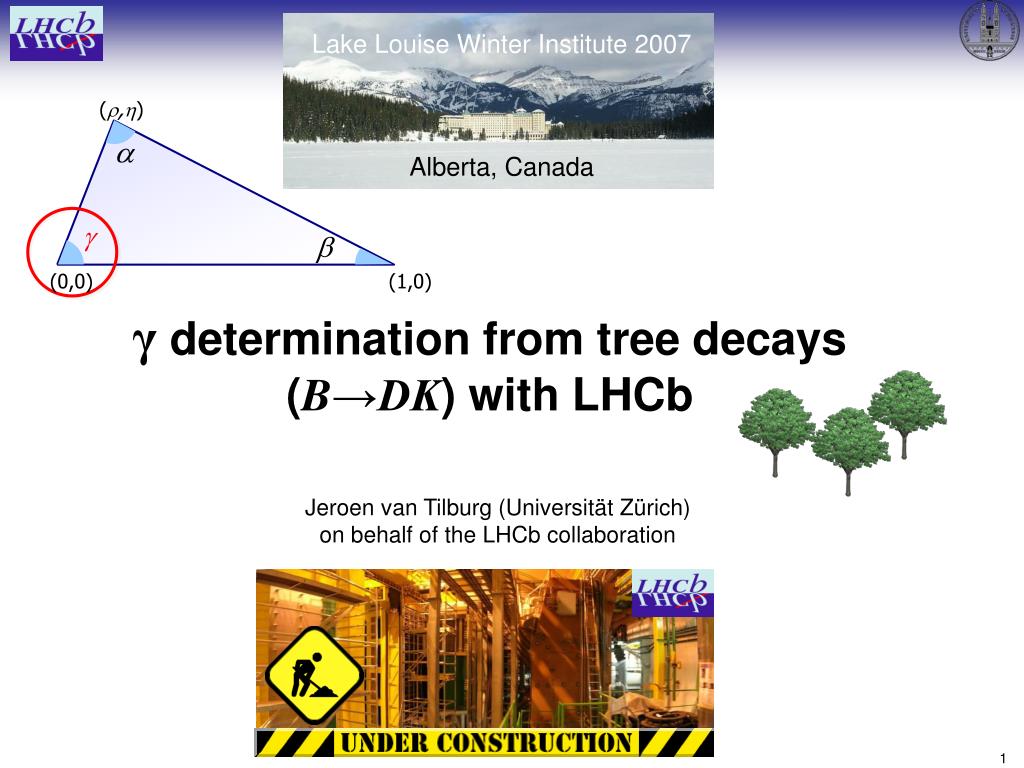
Lake Louise Winter Institute 2007 Alberta, Canada. ( , ). (0,0). (1,0). γ determination from tree decays ( B →DK ) with LHCb. Jeroen van Tilburg (Universit ä t Zürich) on behalf of the LHCb collaboration. Hunting for angle γ. Current experimental status :
(0,0) - slide 1
01 / 11(0,0)
1 / 17

Télécharger la présentation

(0,0)
Une image / un lien ci-dessous est fourni (tel quel) pour télécharger la présentation

Politique de téléchargement : le contenu du site vous est fourni TEL QUEL pour votre information et votre usage personnel ; il ne peut être vendu, concédé sous licence ni partagé sur d’autres sites sans l’accord de son auteur.Le contenu vous est fourni TEL QUEL, pour votre information et votre usage personnel uniquement. Téléchargez la présentation en cliquant sur ce lien. Lors du téléchargement, si vous ne parvenez pas à télécharger une présentation, l’éditeur a peut-être supprimé le fichier de son serveur.Pendant le téléchargement, si vous ne parvenez pas à obtenir une présentation, le fichier a peut-être été supprimé par l’éditeur.

F I N

Plus de contenu associé

Transcription de la présentation
  1. Lake Louise Winter Institute 2007 Alberta, Canada (,) (0,0) (1,0) γ determination from tree decays (B→DK) with LHCb Jeroen van Tilburg (Universität Zürich)on behalf of the LHCb collaboration

  2. Hunting for angle γ • Current experimental status: • From direct measurements withB→DK decays:γ=(82±20)°(BaBar and Belle) • From the SM fit using only indirect measurements: γ=(64.2±4.3)°(UTFit) • Diagrams with b→c and b→u transitions → sensitive to γ. • Use only tree diagrams to allow clean extraction of γ. • Bs→DsK • Measures weak phaseγ-2. • Mixing phase: -2=-0.04to be measured by LHCb using Bs→J/ψ φ channel (see tomorrow’s talk by Peter Vankov). • Decay not yet been measured. • B→D0K • Measures weak phaseγ directly. • ADS+GLW method • GGSZ (Dalitz) method

  3. Bs→DsK decay → need flavour tagging to distinguish between initial and Feynman tree diagrams Interference between direct decay and decay after oscillation Four time-dependent decay rates: Sensitivity to γ

  4. Experimental aspects: Bs→DsK • Average Ds decay distance ~ 6 mm (Bs ~ 11 mm) • Subsequent Ds decay: (BF=4.4%) • Estimated branching fraction for full Bsdecay: (1.0 ± 0.4) x 10-5 • Bs decay time resolution: 39 fs • Flavour tagging power (opposite and same side): • Total trigger efficiency (L0 + HLT): 30% Ds mass resolution: 6 MeV Decay time error estimate

  5. Specific background: Bs→ Dsπ • Special background channel: Bs→ Dsπ • 12 times larger BF than Bs→ Ds K • Use RICH detectorsand mass resolutionto distinguish both channels: • Fraction of Bs→Dsπin Bs→ DsK estimated to be B/S=0.15±0.05. • Not only a background: • Bs→ Dsπis also a control channel: tagging dilution. • Also, Bs→ Dsπ golden mode to measure Δms • sensitivity with 2 fb-1~ 0.01 ps-1 Optimize significance PID likelihood from RICH detector Bs mass resolution 14 MeV

  6. Signal yield and background • Backgrounds considered: minimum bias, generic bb events, specific B events. • Difficult to simulate enough background. • Too few events are left after final selection. • Only upper limit given for background estimate. All cuts applied Expected event yields/2fb-1 B/S Bs→ Dsπ 140k <0.5 Bs→ Ds K 6.2k <0.5 (2 fb-1 corresponds to nominal year in LHCb) • Outlook: Bs→Ds*K also sensitive to γ-2. • Challenge: reconstruct soft photon from decay • Preliminary study: ~1.8k events per 2 fb-1.

  7. Bs→DsK sensitivity on γ • Sensitivity determination: • Full realistic MC simulation.Determine performance numbers: • Decay time resolution, trigger and reconstruction efficiency, tagging performance, mass resolution, … • Fast MC study: only generate decay times, flavour tag, mass distribution. • Simulate typically 100 LHCb experiments. • Unbinned likelihood fit on decay time distributions ofBs→DsK andBs→Dsπ. Observed decay times Bs→DsK Sensitivity with 2 fb-1 σ(γ) ~ 13° w/o tagging σ(γ) ~ 29°

  8. B±→ D0K± with ADS Atwood, Dunietz and Soni, Phys. Rev. Lett. 78, 3257 (1997). • Charged B decay rB=0.075±0.030 colour favoured colour suppressed Amplitude ratio • D0and D0 can both decay into K-π+ (or K+π- ) rD=0.060±0.003 Cabibbo favoured doubly Cabibbo suppressed • Four decay rates: • two favoured with small interference • two suppressed with large interference • Counting experiment: no flavour tagging, no measurement of decay time. • Only sensitive to NP in D0mixing 5 parameters (rB, rD, δB,δD, γ), but only 3 relative decay rates… (rD well-measured, but only a constraint expected on cosδD~20% from CLEO-c)

  9. B→ D0K strategy: ADS+GLW • Simultaneous fit for allB±→ D0K±decays: • Add D0 decay mode:D0→Kπππ • adds 3 observables and 1 unknown strong phaseδK3π (rDK3πalso well measured). • AddCP eigenstate decays D0→KK/ππ (GLW method) • Adds one observable, no additional unknowns. • Combined fit: ADS+GLW LHCb performance: • Charged B decays: Expected event yields/2fb-1 B/S Sensitivity with 2 fb-1 σ(γ) ~ 5°-15° (depends on strong phase δD) 112k 0.6 1.4k ~3 7.6k ~2 • Neutral B decays: (same method can be applied) Expected event yields/2fb-1 B/S Sensitivity with 2 fb-1 σ(γ) ~ 7°-10° (depends on strong phase δD) 3.4k <0.3 0.5k <1.7 0.6k <1.4

  10. B±→ D0K± with GGSZ Giri, Grossman, Soffer, Zupan Phys. Rev. D68 054018 (2003). When D0decays into a 3 (or 4) body CP eigenmode: → interference between D0 Dalitz plots. D0 decay considered: Dalitz analysis: Many resonances Expected event yields/2fb-1 0.2 < B/S < 1.0 (90% CL) Sensitivity with 2 fb-1 σ(γ) ~ 8° current Dalitz uncertainty ~11° (to be improved) 5k Similar method will be used for KsK+K-

  11. Conclusions • B→DK tree decays involve b→c and b→u transitions→ allow a theoretically clean extraction of CKM angle γ. • Direct measurements of γ needed to put severe constraints on the Unitarity Triangle. • Bs mode: Bs→ DsK • Relies on good decay time resolution (~39 fs) and tagging power (~9%). • Sensitivity determined from fast MC and likelihood fit ~13° with 2 fb-1. • Charged and neutral B→D0K decays: • Promising and clean channels. • Different methods (ADS+GLW, GGSZ) explored. • Combining all methods sensitivity on γ with 2 fb-1 estimated to be roughly 5°. • Interesting comparison with indirect measurements and between the different methods.