Transforming IT Services: Insights from Mark Michaelis on Integration and Architecture
Mark Michaelis is a distinguished Chief Technical Architect, author, and trainer focused on innovative Information Technology services. He specializes in Integration and Enterprise Service Bus development, addressing complex problem spaces from AMR to AMI. Through best practices in application lifecycle management and disciplined agile development, he emphasizes responsible design, continuous integration, and user collaboration. With extensive experience in software architecture consulting, he excels at aligning technology solutions with business goals, ensuring optimal performance and risk management.

Transforming IT Services: Insights from Mark Michaelis on Integration and Architecture
E N D
Presentation Transcript
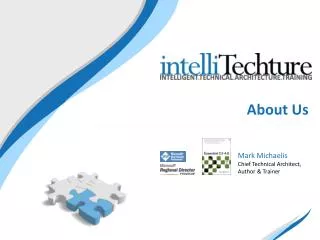
AboutUs Mark Michaelis Chief Technical Architect, Author & Trainer
The Variables Behind and questionable Ready to go
Best Practice Application Lifecycle Management • Disciplined Agile Developmentturning up the volume on what works • Responsible design • Constant project pulse • Test early and often • Integrated user participation • Visual Studio and Team Foundation Server • Product Quality - continuous integration and testing
Enterprise Collaboration and Content Management • SharePoint Corporate Portal • Simplify Collaboration • Simplify Posting • Facilitate Search and Navigation • Enterprise Document Management • Consolidation of Services
Software Architecture Consulting • Intense architecture engagements • Architecture design diagrams • Use case modeling • Vertical implementation • Security reviews and design • System layout • Scope clarification • Call chain modeling
Technical Discovery • Discover clients concerns and priorities • Seek best suited global solutions • Determine: • Performance • Timelines • Cost • Risk • Compatibility with existing projects and plans • Build comparative risk model • Incorporate into a dynamic relational roadmap
Solution Engineering • Combine technical options and timelines into a series of workable solutions • Determine dependencies • Communications • Hardware • Software • Lifetime and obsolescence • Other projects (existing and under consideration) • Prioritize solutions • Cost/performance comparison • Implementation time
Scenario Modeling • View end results of a range of program combinations: • Investigate and compare: • Overall system performance • Likelihood of success • Optimize implementation schedules • Readjust for: • Delays • Cancellations • New technologies • Changing market and business imperatives • Plot capacity v. demand curves • Plot best and worst case for a series of combined scenarios