SlideServe
Menu
Préférences
© SlideServe · v2026

Equity Valuation Process

tahirah avatar
16 diapositives · 678 Views · Feb 18, 2014

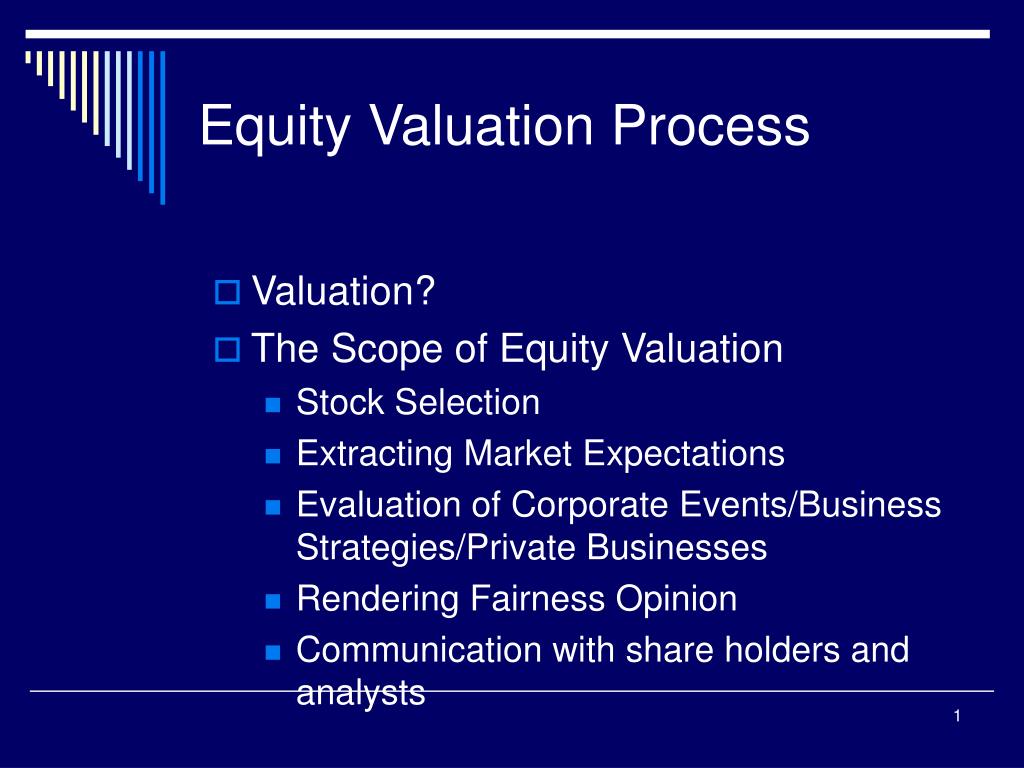
Equity Valuation Process. Valuation? The Scope of Equity Valuation Stock Selection Extracting Market Expectations Evaluation of Corporate Events/Business Strategies/Private Businesses Rendering Fairness Opinion Communication with share holders and analysts . Equity Valuation Process.
Equity Valuation Process - slide 1
01 / 16Equity Valuation Process
1 / 17

Télécharger la présentation

Equity Valuation Process
Une image / un lien ci-dessous est fourni (tel quel) pour télécharger la présentation

Politique de téléchargement : le contenu du site vous est fourni TEL QUEL pour votre information et votre usage personnel ; il ne peut être vendu, concédé sous licence ni partagé sur d’autres sites sans l’accord de son auteur.Le contenu vous est fourni TEL QUEL, pour votre information et votre usage personnel uniquement. Téléchargez la présentation en cliquant sur ce lien. Lors du téléchargement, si vous ne parvenez pas à télécharger une présentation, l’éditeur a peut-être supprimé le fichier de son serveur.Pendant le téléchargement, si vous ne parvenez pas à obtenir une présentation, le fichier a peut-être été supprimé par l’éditeur.

F I N

Plus de contenu associé

Transcription de la présentation
  1. Equity Valuation Process • Valuation? • The Scope of Equity Valuation • Stock Selection • Extracting Market Expectations • Evaluation of Corporate Events/Business Strategies/Private Businesses • Rendering Fairness Opinion • Communication with share holders and analysts

  2. Equity Valuation Process • Valuation and Portfolio Management • Planning • Setting investment objectives • Internal and external constraints • Investment strategy • Issues with benchmark • Active vs. passive management • Execution • Portfolio composition decision • Portfolio implementation decision • Feedback • Performance evaluation • Portfolio revision

  3. Equity Valuation Process • Valuation Concepts and Models • The Process • Understanding the business • Industry structure, regulation, competitiveness, strategies. • Forecasting company performance • Internal and external constraints • Selecting appropriate valuation model • Dividend growth, uneven growth, CF, FCF,… • Converting forecasts to a valuation • Assumptions • Making the investment recommendation

  4. Equity Valuation Process • Understanding the Business • Industry structure • Underlying economic and technical structure • Size and growth over time • Recent development (technical, financial, management, regulatory…) • Supply / demand imbalance • Competitiveness • Current market share • Growth/trend in market share

  5. Equity Valuation Process • Understanding the Business • Competitive strategy • Cost leadership • Product differentiation • Focus – targeted market segment with cost focus or product differentiation • Execution of strategies • Competent execution of strategies

  6. Equity Valuation Process 2. Forecasting company performance involves forecasts of macroeconomic environment and firm’s own financial characteristics. • Macro Environment • Top-down method • International, national, industry, company … • Bottom- up method • Aggregate individual company forecasts into industry forecast to finally macroeconomic forecasts. • Problems with assumptions

  7. Equity Valuation Process • Financial Forecasting • Qualitative and quantitative factors in forecasting • Quality of Earnings! • Identify appropriate risk factors • Quality of accounting disclosure • High management/director/audit firm turnover • History of securities law violation • Excessive pressure to make revenue targets • Compensation structure

  8. Equity Valuation Process 3. Selecting appropriate valuation model • Intrinsic Value – derived after complete understanding of the asset’s investment characteristics. To be successful, accurate forecasts and appropriate valuation model is essential. • What is Abnormal return (also known as alpha)?

  9. Equity Valuation Process What is Abnormal return or Ex anteα? Ex anteα = E(HPR) – RR E(HPR) = sum of expected capital gains and investment income. RR = Fair or equilibrium return given its level of risk. How to calculate RR – CAPM or FF? Explain.

  10. Equity Valuation Process What is Abnormal return or Ex postα? Ex postα = Actual (HPR) – Contemporaneous RR Actual (HPR) = sum of actual capital gains and investment income. Contemporaneous RR is based on the current market condition.

  11. Equity Valuation Process 3. Selecting appropriate valuation model • Absolute Valuation Models – used in determining asset’s intrinsic value • Discounted CF model • Discounted FCF to equity model • Discounted FCF to the Firm model • Dividend Discount model • Residual Income model

  12. Equity Valuation Process 3. Selecting appropriate valuation model c. Other Value Measures • Going-concern value – appropriate assumption for publicly traded companies. They have long lives. • Liquidation value – if dissolved now and assets sold individually. • For a profitable going concern, value added by assets plus human capital must > liquidation value • Persistently unprofitable businesses – the relationship is reversed. • Reason for LBO, going private, divestiture. • Liquidation value is the Fair Value.

  13. Equity Valuation Process 3. Selecting appropriate valuation model d. Relative Valuation Models – used in determining value of a going concern relative to that of another asset • Earnings multiplier (P/E) model – low P/E vs. high P/E • Sales multiplier (P/S) model • Cash flow multiplier (P/CF) model

  14. Equity Valuation Process 3. Selecting appropriate valuation model e. Use of appropriate discount rate • Types of risk prmia to be included • Controlling ownership position – Control premium • Non-publicly traded stock – marketability premium • Publicly traded but less depth/breadth – Liquidity premium

  15. Equity Valuation Process 4. Performing valuation Analyst’s Role • Collecting, organizing, analyzing, and communicating corporate information • Help their clients achieve investment objective • Contribute to efficient functioning of capital market • Benefit the supplier of capital by monitoring management performance.

  16. Equity Valuation Process 5. The Report See separate outline