Understanding the Summation Formula: Applications and Derivations of \( S = \frac{n(n+1)}{2} \)
This article explores the fundamental summation formula ( S = 1 + 2 + 3 + ... + n = frac{n(n+1)}{2} ) and its intriguing applications. It delves into scenarios like counting handshakes among ( n ) people, connecting ( n ) cities with cables, arranging cards, appending names in a list, and the mathematical anecdote of Gauss’s clever summation method. The derivation is examined through various approaches, emphasizing combinatorial reasoning to derive the formula and correct counting methods in handshake problems.

Understanding the Summation Formula: Applications and Derivations of \( S = \frac{n(n+1)}{2} \)
E N D
Presentation Transcript
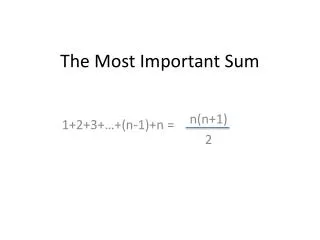
The Most Important Sum 1+2+3+…+(n-1)+n = n(n+1) 2
Applications: • n people; how many handshakes? • (equivalent:ncities to directly connect with an internet cable; how many cables needed?) • Arranging n cards in order: how many compares? • Appending to a list of names: how many steps? • Keeping students busy (anecdote: Gauss)
Three derivations • Gauss' approach: 1 + 2 + 3 + … + (n-2) + (n-1) + n = S n +(n-1)+(n-2)+ … + 3 + 2 + 1 = S (n+1)+(n+1)+(n+1)+…+(n+1) + (n+1) + (n+1) = 2S n(n+1) = S 2
Three Derivations (part 2) 1 2 3 . . . n-1 n . . . . . . . . . 1 2 3 n-1 n
Three Derivations (part 2) . . . 1 2 3 . . . n-1 n . . . . . . . . . . . . n(n+1) = S 2 . . . 1 2 3 n-1 n
Three Derivations (part 3) Count the ways to create a handshake: • Choose the 1st person (n choices) • Choose the 2nd person (n-1 remaining choices) • That's n(n-1) ways to choose one then the other. • But this overcounts: "Choose Alice then Bob" and "Choose Bob then Alice" are the same handshake; divide by 2 to correct. S = n(n+1) 2