Download
1 / 5
60 likes | 199 Vues
This guide explains the concept of formal charge in molecular structures. It outlines essential rules, including the assumptions that lone pairs belong only to the atom in question and that shared electrons are equally divided. The formal charge formula is presented as: FC = (number of valence electrons on a free atom) - (number of valence electrons assigned in the molecule). Emphasis is placed on achieving minimal formal charges for stable bond structures, with examples highlighting that the negative charge should ideally be on the most electronegative atom.

E N D
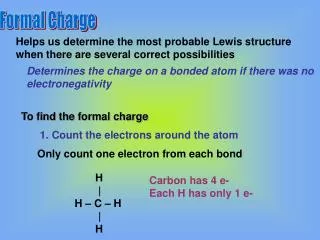
Formal Charge Rules • Assumptions: • Lone pairs belong only to the atom in question. • Shared electrons are divided equally between the two sharing atoms.
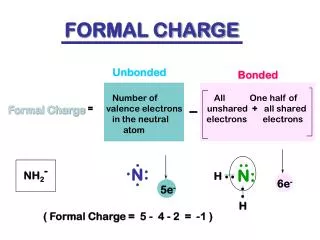
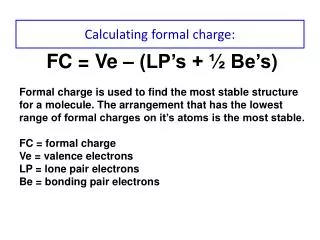
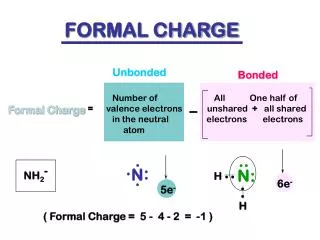
Formal Charge Rules • Formal Charge (FC) = (# of v.e-s on a free atom) – (# of v.e-s assigned to the atom in the molecule) • V.e-s assigned to an atom = (# of lone pair electrons) + ½(# of shared electrons) • FC = (# of v.e-s on a free atom) - [(# of lone pair electrons) + ½(# of shared electrons)]
Examples • P.406: 73
Minimal Formal Charges • The most stable bond structure puts the smallest formal charge on each atom. • As close to zero as possible! • Any negative formal charge should reside on the most electronegative atom in the molecule. • Example: Examine Sample Exercise (p.388) • Examples: P.406: 744