A Guide to Solving Murder Mysteries: Investigative Steps and Considerations
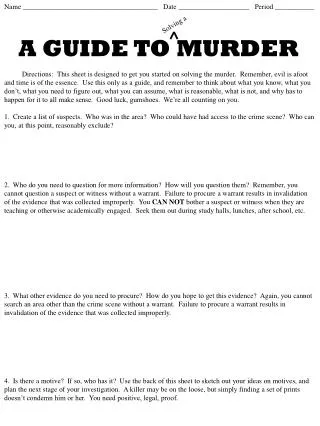
This guide serves as an essential tool for aspiring detectives tackling a murder case. It emphasizes the urgency of the situation and provides a structured approach to solving the mystery. Start by creating a list of suspects, identify whom to question, and understand the limitations imposed by the law regarding evidence collection. Determine any potential motives and strategize your investigation. Remember, gathering legally admissible evidence is crucial to ensure justice prevails. Good luck, detectives; the community relies on your skills!

A Guide to Solving Murder Mysteries: Investigative Steps and Considerations
E N D
Presentation Transcript
Name ______________________________________ Date ____________________ Period ___________ Solving a A GUIDE TO MURDER Directions: This sheet is designed to get you started on solving the murder. Remember, evil is afoot and time is of the essence. Use this only as a guide, and remember to think about what you know, what you don’t, what you need to figure out, what you can assume, what is reasonable, what is not, and why has to happen for it to all make sense. Good luck, gumshoes. We’re all counting on you. 1. Create a list of suspects. Who was in the area? Who could have had access to the crime scene? Who can you, at this point, reasonably exclude? 2. Who do you need to question for more information? How will you question them? Remember, you cannot question a suspect or witness without a warrant. Failure to procure a warrant results in invalidation of the evidence that was collected improperly. You CAN NOT bother a suspect or witness when they are teaching or otherwise academically engaged. Seek them out during study halls, lunches, after school, etc. 3. What other evidence do you need to procure? How do you hope to get this evidence? Again, you cannot search an area other than the crime scene without a warrant. Failure to procure a warrant results in invalidation of the evidence that was collected improperly. 4. Is there a motive? If so, who has it? Use the back of this sheet to sketch out your ideas on motives, and plan the next stage of your investigation. A killer may be on the loose, but simply finding a set of prints doesn’t condemn him or her. You need positive, legal, proof.