Download

1 / 10
100 likes | 219 Vues
The skeletal system is more than just bones; it includes cartilages, joints, ligaments, and connective tissues. It serves five primary functions: support, storage, blood cell production, protection, and leverage. It provides structural support, serving as a framework for tissues and organs. Bones store vital calcium and lipids, and red marrow produces blood cells. They also protect delicate organs like the heart, lungs, and brain while acting as levers that enable movement. Discover the essential roles of the skeletal system in maintaining a healthy body.

E N D
The Skeletal System http://www.youtube.com/watch?v=vya4wpS2fgk
Introduction • The skeletal system is not just made up of bones. • It is made up of bones, cartilages, joints, ligaments, and other connective tissues. • The skeletal system has 5 primary functions………
5 Functions 1.Support 2.Storage 3.Blood Cell Production 4.Protection 5.Leverage
Support • The skeletal system provides structural support for the entire body. • Individual bones, or groups of bones provide a framework for the attachment of soft tissues and organs. Th
Support • Your bones are as strong as CONCRETE, but lighter. • That is why your bones can support the weight of your body. • Without the skeleton to pull against, muscles would not be able to make us sit, stand, run, or even walk.
Storage • Bones are a storage center for calcium salts. • Calcium salts maintain normal concentrations of calcium and phosphate ions in body fluids.
Storage • Calcium ions have a lot to do with the CLOTTING PROCESS. • Bones also store lipids in yellow marrow.
Blood Cell Produciton Th • Red blood cells, white blood cells, and other blood elements are produced in the RED MARROW of the bone. • Red marrow fills the internal cavities of many bones.
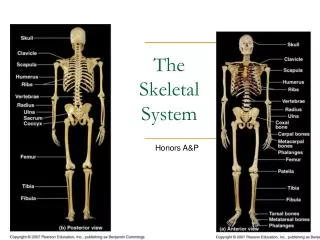
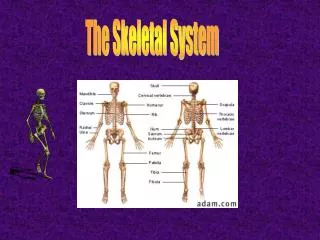
Protection • Soft tissues and organs are usually surrounded by bones or skeletal elements. • Ribs protect the heart andlungs • Skull encloses the brain • Vertebrae shield the spinal cord • Pelvis protect important digestive and reproductive organs.
Leverage • The bones act as levers • These levers can change magnitude and direction of the forces generated by skeletal muscles. • The resulting movements can be as simple as the motion of a fingertip to doing a backflip.