Download
1 / 9
101 likes | 249 Vues
This lesson plan focuses on warm-up activities to help students write decimals as fractions and understand their relationships. Students will practice converting decimals such as 0.6, 1.25, 0.74, and 0.20 to their fractional equivalents. The objectives include interpreting, comparing, and ordering decimals using the decimal place-value system. Engaging questions will encourage discussion about the size of decimals and strategies for comparison. Activities will build fluency in mathematical concepts through exploration and summarization, ensuring a solid understanding of decimals.

E N D
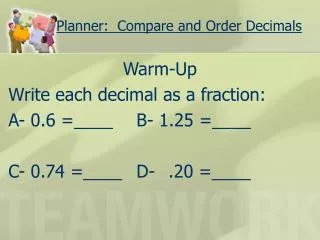
Planner: Compare and Order Decimals Warm-Up Write each decimal as a fraction: A- 0.6 =____ B- 1.25 =____ C- 0.74 =____ D- .20 =____
Warm-Up • Write each decimal as a fraction: A- 0.6 =6/10, 3/5 B- 1.25 =125/100, 1 25/100, 1 ¼ C- 0.74 =74/100, 37/50 D- .20 =20/100, 2/10, 1/5
Mathematical Goals • Use the decimal place-value system to interpret, compare, and order decimals. • Connect understanding of decimals as fractions to the interpretation of decimals as an extension of the place-value system. • Develop strategies for comparing and ordering decimals.
LAUNCH: GETTING READY! • Which of the numbers in the Getting Ready is the largest? Which is the smallest? • But 0.00002 has more digits than the others. Why isn’t it larger? • Which of these numbers—0.35 or 0.305—is larger? Why? • When you look at two decimals, how can you tell which is larger? • Do these ideas make sense? Consider that while doing the problem.
SUMMARIZE • Who is taller, Lana or Maria? • How did you decide to order the numbers? • How did you decide that Fred and Abey went in that order? • Which is involved in more accidents, televisions or toilets? • Tell me how you know there are more table than ladder injuries.
SUMMARIZE • Who is the tallest student? Shortest? Who is in the middle? • Did anyone get a different order? • Describe in words a process for comparing two decimal numbers. • Does anyone have another way? • How do these methods compare? Check for Understanding 1. Order from smallest to largest: 0.21, 0.201, 0.2001, 0.20001. 2. Place a <, =, or > sign between each pair to show their relationship. a. 1.31 _____ 20.31 b. 0.109 _____ 0.19 c. 0.10 _____ 0.01 3. Which is closer to 1? a. 0.89 or 0.9 b. 0.001 or 1.01