The Fascinating Gila Monster: Habitat, Diet, and Survival Traits
70 likes | 216 Vues
The Gila Monster thrives in the arid regions of Southern America and Mexico, adept at surviving in hot climates. Its remarkable adaptations, such as powerful claws for digging burrows, allow it to navigate its dry habitat. A carnivorous predator, the Gila Monster feeds on eggs, small mammals, birds, and reptiles, playing an essential role as a secondary consumer in its ecosystem. The name Gila Monster is derived from the Gila River, and its scientific name is Heloderma suspectum. This unique lizard exhibits noteworthy behaviors, including using venom to immobilize prey before consumption.


The Fascinating Gila Monster: Habitat, Diet, and Survival Traits
E N D
Presentation Transcript
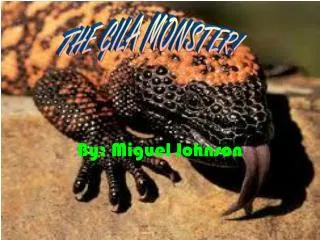
THE GILA MONSTER! By: Miguel Johnson
HABITAT • The Gila Monster is located mostly by Southern America and Mexico. • They are used to the dry lands and can live in hot temperatures.
ADAPTATIONS The adaptation that helps it survive the most would probably be the claws by helping it dig burrows underground. • Finding Food. • Walking. • Climbing. • Hunting. Inherited Learned • Eating. • Color. • Tongue Formation. • Breathing.
DIET • The Gila Monster eats eggs, small mammals, birds and reptiles. • It is a carnivore. • It is a predator and a prey, so that makes it a secondary consumer.
Intresting Facts • It’s name comes from the Gila River, where which it was found. • It bites its prey but does not eat it. It waits until the venom goes completely through the body, then it eats it. • Its scientific name is “the Helloderma Suspectum.”
PICS! RA!!!!!