SlideServe
Menu
Préférences
© SlideServe · v2026

Atomic Theory

tamyra avatar
21 diapositives · 406 Views · Oct 09, 2014

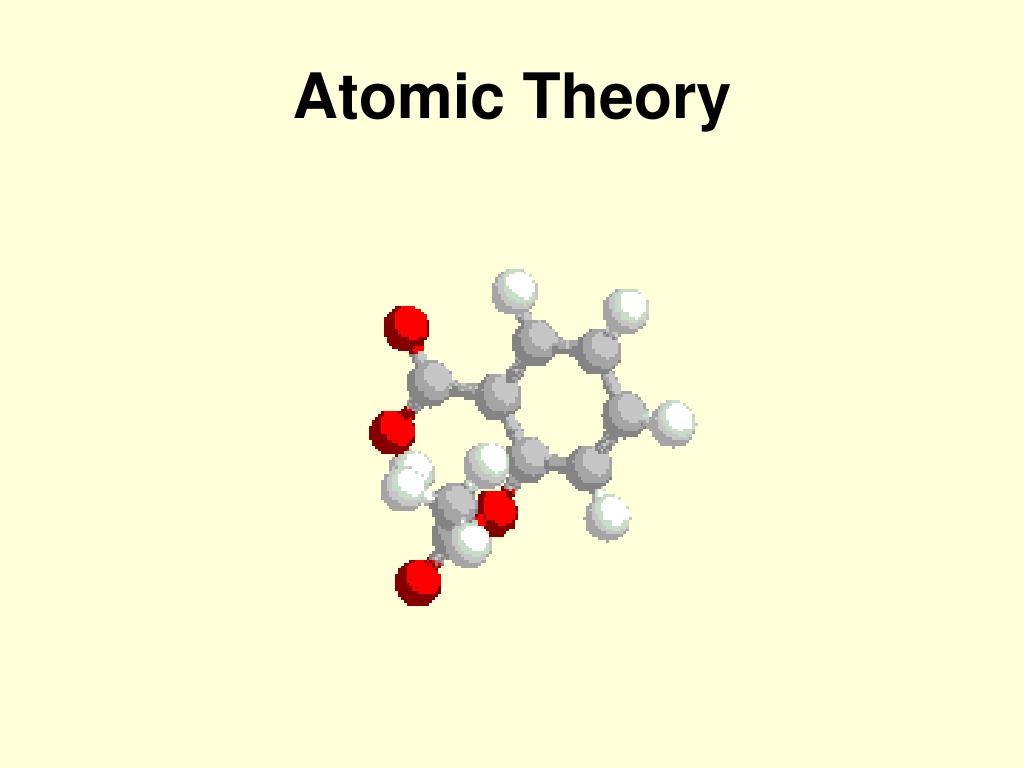
Atomic Theory. Let’s Take a Trip Through Time!. Atomic Theories Timeline. Democritus 460 – 370 B.C. There are various basic elements from which all matter is made Everything is composed of small atoms moving in a void
Atomic Theory - slide 1
01 / 21Atomic Theory
1 / 17

Télécharger la présentation

Atomic Theory
Une image / un lien ci-dessous est fourni (tel quel) pour télécharger la présentation

Politique de téléchargement : le contenu du site vous est fourni TEL QUEL pour votre information et votre usage personnel ; il ne peut être vendu, concédé sous licence ni partagé sur d’autres sites sans l’accord de son auteur.Le contenu vous est fourni TEL QUEL, pour votre information et votre usage personnel uniquement. Téléchargez la présentation en cliquant sur ce lien. Lors du téléchargement, si vous ne parvenez pas à télécharger une présentation, l’éditeur a peut-être supprimé le fichier de son serveur.Pendant le téléchargement, si vous ne parvenez pas à obtenir une présentation, le fichier a peut-être été supprimé par l’éditeur.

F I N

Plus de contenu associé

Transcription de la présentation
  1. Atomic Theory

  2. Let’s Take a Trip Through Time!

  3. Atomic Theories Timeline

  4. Democritus460 – 370 B.C. • There are various basic elements from which all matter is made • Everything is composed of small atoms moving in a void • Some atoms are round, pointy, oily, have hooks, etc. to account for their properties • Ideas rejected by leading philosophers because void = no existence

  5. First Concept of an Atom Pick a Candy !

  6. John Dalton1766-1844 • Introduced his ideas in 1803 • Each element is composed of extremely small particles called atoms • All the atoms of a given elementare identical, but they differ from those of any other element • Atoms are neither created nor destroyedin any chemical reaction • A given compound always has the same relative numbers and kinds of atoms

  7. Dalton’s Model Pick a Candy !

  8. J.J. Thompson1856-1940 • Discovered electron 1897 – Cathode Ray Experiment • Plum Pudding model 1904 • Electrons in a soupof positive charges • Discovered isotopes 1913

  9. JJ Thompson’s Ideas

  10. Cathode Ray Tube Experiment

  11. Plum Pudding Model Pick a Candy!

  12. Ernest Rutherford1871-1937 • Nucleus Theory 1910 • alpha particle gold foil experiment • An atom’s mass is mostly in the nucleus • The nucleus has a positive charge (Moseley) • Electrons in fixed orbit

  13. Alpha Particle Experiment

  14. Rutherford Model Pick a Candy!

  15. Niels Bohr1885-1962 • Planetary Model 1913 • Nucleus surrounded by orbiting electrons at different energy levels • Electrons have definite orbits • Utilized Planck’s Quantum Energy theory • Worked on the Manhattan Project (US atomic bomb)

  16. Bohr’s Model

  17. Bohr Model for Nitrogen Pick A Candy!

  18. Ernst Schrödinger 1887-1961 Werner Heisenberg 1901-1976 • Quantum Mechanical Model 1926 • Electrons are in probability zones called “orbitals”, not orbits and the location cannot be pinpointed • Electrons are particles and waves at the same time • Developed quantum numbers based on theories of Einstein and Planck

  19. Orbitals

  20. Quantum Mechanical TheoryElectron in a Hydrogen atom Pick A Candy!