Download
1 / 23
230 likes | 343 Vues
This paper explores the vital role of Public Sector Reform (PSR) in ensuring fiscal sovereignty amidst challenges such as high debt and inefficient governance. Drawing on case studies from Jamaica, Canada, Ireland, and others, it showcases successful PSR initiatives addressing wage management, transparency, accountability, and service efficiency. The research emphasizes the significance of context-specific solutions, continuous reform, and the need for a culture change within public institutions. Ultimately, it presents critical findings and recommendations to foster effective governance and sustainable public sector improvement.

E N D
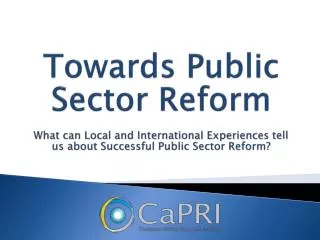
Towards Public Sector ReformWhat can Local and International Experiences tell us about Successful Public Sector Reform?
OUTLINE • Introduction • PSR & Debt Management • Research Agenda • Overview of Cases • PSR in Jamaica • PSR in Other Countries • Findings & Recommendation • Conclusion
INTRODUCTION • IMF/GOJ 27-month Stand-By Arrangement, Feb. 2010 • Context • Global financial crisis • Longstanding structural problems • Key features • Debt restructuring: JDX, 2010 • Tax reform: Green Paper • Public Sector Reform (PSR)
Key to sustaining these reforms and to the government’s ability to achieve fiscal sovereignty is its ability to address Public Sector Reform
PSR & DEBT MANAGEMENT • Public sector wages = 12% of GDP • Large public sector is a tax • Debt reduces quantity & quality of public services
CHALLENGES • How to achieve ‘successful’ PSR? • What to reform? How? • Solution: Lesson-drawing & experiential learning
RESEARCH METHOD • Case studies • Canada, Ireland, Barbados, Sweden, New Zealand, Jamaica • Selection method: • Demonstrate ‘successful’ instances of PSR • Faced similar conditions • Understanding own context and experience • Data collection • Desk Research • Elite interviews
JAMAICAN EXPERIENCE with PSR • Administrative Reform Programme, 1984-1995 • Aims: Tax admin, improve budgeting & financial mgt., cut costs, improve staff quality • Problems: local ownership, unclear vision & objectives, implementation capacity, poor planning & budgeting, continuity & lack of support, backtracking on reforms • Public Sector Modernisation Programme, 1996-2002 • Aims: modernise & re-define the state, fiscal austerity, increase efficiency & quality of public services, improve accountability • Problems: funding, politically unpopular decisions, uneven gains • Overall, these have seen some improvements: greater skills, capacity, efficiency, etc. but …
WASTEFULNESS OF GOVERNMENT SPENDING • Key: 1=Extremely wasteful; 7= Highly Efficient, • Source: Compiled from World Economic Forum (2009).
BURDEN OF REGULATIONS 1=impossible; 7=extremely easy
PRE-CONDITIONS FOR REFORM • High debt • Canada: 68.4%, Ireland: 125% • Fiscal deficits • Barbados: 8.4%, Sweden: 10%, Ireland: 10% • Large public sector employment • Economic contraction • Barbados: –3.9%, Sweden: –2.0%
KEYS FOR SUCCESS • Never let a crisis go to waste • Reform must be continuous and comprehensive • Investigate the causes of problem • PSR involves a reduction in the size and cost of the public sector • E.g. wage freeze; use of CVOs through the social enterprise model; contracting out; privatisation; reduction in personnel; efficiency savings • But must: • include greater regulatory & enforcement capacity • not deplete public sector morale • involve attention to building ‘a public sector ethic’ • clarity and consistency
KEYS FOR SUCCESS • Pay attention to productivity and performance • agreed efficiency targets • indeterminate employment & remuneration • employee share ownership schemes • removal of perverse incentives • increase enforcement and punishment • Public sector must be an engine for innovation & entrepreneurship
KEYS FOR SUCCESS • ISRmust include attention to the revenue side: • Tax increases – not sustainable • Tax reform necessary & many studies exist on this • Mantra for tax reform: simplify, unify and enforce, equitably • identification of new income sources • Reclaiming 'lost' investments • Role of the Diaspora • Bonds & un-reclaimed earnings • Accountability & transparency in government spending
KEYS FOR SUCCESS • Not just the “what” but also the “how” • Is design and implementation inclusive? • Can broad goals be translated into fixed targets? • How are reforms sequenced? • How are achievements measured? By whom? • Build support for implementation & sustenance • Attention to symbolism • Civil servants and the public must be aware of requirement for success • Mindful of the effect on the poorest
KEYS FOR SUCCESS • Better management of contingent liabilities • E.g. Cost of natural disasters • Open budgeting • Leadership • Civil service • Implementing & monitoring body • Political • The private sector has a role
CONCLUSION • PSR is • Not only about a cutting government but also about improvements in governance • Not only about what to cut but how • Is inherently contentious and divisive but has many winners • Successful PSR requires a change in mind-set and organisational culture • Cannot be undertaken without requisite attention to issues of productivity and performance
Towards Public Sector ReformWhat can Local and International Experiences tell us about Successful Public Sector Reform?