Examining Voltage Drops Around a Closed Loop
This guide explores the analysis of voltage drops around a closed loop circuit using 220Ω and 470Ω resistors. You'll learn how to identify these resistors from your Boe-Bot kit and build a series circuit on a breadboard. The process involves computing total current and applying Ohm's Law to find voltage drops across each resistor. Using a multimeter, you'll measure voltages to validate Kirchhoff’s Voltage Law (KVL), ensuring the algebraic sum of voltages around the loop equals zero. This hands-on approach reinforces theoretical concepts in electrical circuits.
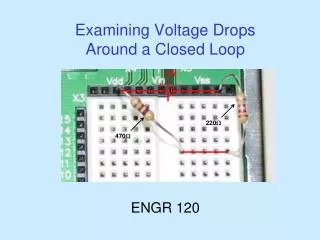

Examining Voltage Drops Around a Closed Loop
E N D
Presentation Transcript
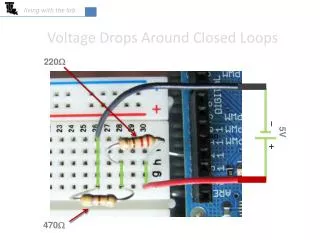
5V Examining Voltage Drops Around a Closed Loop + - 220W 470W ENGR 120
Select Resistors Find the 220W and the 470W resistors from your Boe-Bot kit. Example: 470W resistor: 4 = yellow 7 = violet Add 1 zero to 47 to make 470, so 1 = brown So, 470 = yellow, violet, brown Now, find the 220W resistor.
Build the Series Circuit Below 5V + - 220W 470W the breadboard connects these resistors
Compute the Voltage Drops Across the Two Resistors (Hint: compute the total current provided by the power source and then apply Ohm’s Law to each resistor) 5V + - DV = 220W 470W SOLUTION: DV = Now, add the voltage rise of the power source (+5V) to the voltage drops across the resistors (negative numbers). V – V – V = V
Use Multimeter to Measure Voltages Around Loop (1) From Vdd to Vss DV1 = _____ (2) Across the 470W resistor DV2 = _____ Remember . . . a RESISTOR is a voltage DROP and a POWER SOURCE is a voltage RISE DV1 - DV2 - DV3 = ________ (3) Across the 220W resistor DV3 = _____ Rises must balance drops!!!!
Compare Measurements to Theory DV = DV = How close are your experimental and theoretical results?
Kirchoff’s Voltage Law (KVL) Kirchoff’s Voltage Law says that the algebraic sum of voltages around any closed loop in a circuit is zero – we see that this is true for our circuit. It is also true for very complex circuits. DV = V – V – V = V DV = Notice that the 5V is DIVIDED between the two resistors, with the larger voltage drop occurring across the larger resistor.
Gustav Kirchoff (1824 – 1887) was a German physicist who made fundamental contributions to the understanding of electrical circuits and to the science of emission spectroscopy. He showed that when elements were heated to incandescence, they produce a characteristic signature allowing them to be identified. He wrote the laws for closed electric circuits in 1845 when he was a 21 year-old student. The End Photo: Library of Congress