Download
1 / 26
260 likes | 384 Vues
This lecture by Pushpak Bhattacharyya from IIT Bombay delves into the principles of self-organization in neural networks, inspired by biological systems, particularly the human brain. It covers the structure and functions of the brain's higher regions, such as the cerebrum and cerebellum, and discusses concepts like Maslow’s hierarchy and the dichotomy of left and right brain functions. The lecture explores the Kohonen Self-Organizing Maps (SOM), detailing competitive learning, weight adjustment, and neighborhood functions crucial for clustering and feature extraction. It provides insight into advanced neural network architectures like the NeoCognitron.

E N D
CS623: Introduction to Computing with Neural Nets(lecture-20) Pushpak Bhattacharyya Computer Science and Engineering Department IIT Bombay
Self Organization Biological Motivation Brain
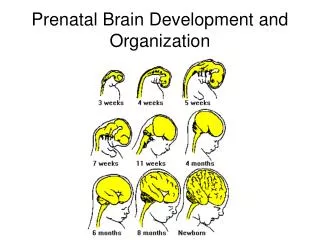
Higher brain Brain Cerebellum Cerebrum 3- Layers: Cerebrum Cerebellum Higher brain
Maslow’s hierarchy Search for Meaning Contributing to humanity Achievement,recognition Food,rest survival
Higher brain ( responsible for higher needs) 3- Layers: Cerebrum (crucial for survival) Cerebrum Cerebellum Higher brain
Mapping of Brain Back of brain( vision) Lot of resilience: Visual and auditory areas can do each other’s job Side areas For auditory information processing
Left Brain and Right Brain Dichotomy Left Brain Right Brain
Words – left Brain Music Tune – Right Brain Left Brain – Logic, Reasoning, Verbal ability Right Brain – Emotion, Creativity Maps in the brain. Limbs are mapped to brain
Character Recognition: A, A, A, , , O/p grid . . . . I/p neuron
Kohonen Net Self Organization or Kohonen network fires a group of neurons instead of a single one. The group “some how” produces a “picture” of the cluster. Fundamentally SOM is competitive learning. But weight changes are incorporated on a neighborhood. Find the winner neuron, apply weight change for the winner and its “neighbors”.
Winner Neurons on the contour are the “neighborhood” neurons.
Neighborhood: function of n Weight change rule for SOM W(n+1) = W(n) + η(n) (I(n) – W(n)) P+δ(n) P+δ(n) P+δ(n) Learning rate: function of n δ(n) is a decreasing function of n η(n) learning rate is also a decreasing function of n 0 < η(n) < η(n –1 ) <=1
Winner δ(n) Convergence for kohonen not proved except for uni-dimension Pictorially . . . .
A … P neurons o/p layer Wp … … . n neurons Clusters: A : A : : B : C :
Clustering Algos 1. Competitive learning 2. K – means clustering 3. Counter Propagation
…… 26 neurons K – means clustering K o/p neurons are required from the knowledge of K clusters being present. Full connection …… n neurons
Steps 1. Initialize the weights randomly. 2. Ik is the vector presented at kth iteration. 3. Find W* such that |w* - Ik| < |wj - Ik| for all j 4. make W*(new) = W* (old) + η(Ik - w* ). 5 K K +1 ; if go to 3. 6. Go to 2 until the error is below a threshold.
Two part assignment Supervised Hidden layer
Cluster Discovery By SOM/Kohenen Net 4 I/p neurons A4 A1 A2 A3
S-Layer • Each S-layer in the neocognitron is intended for extraction of features from corresponding stage of hierarchy. • Particular S-layers are formed by distinct number of S-planes. Number of these S-planes depends on the number of extracted features.
V-Layer • Each V-layer in the neocognitron is intended for obtaining of informations about average activity in previous C-layer (or input layer). • Particular V-layers are always formed by only one V-plane.
C-Layer • Each C-layer in the neocognitron is intended for ensuring of tolerance of shifts of features extracted in previous S-layer. • Particular C-layers are formed by distinct number of C-planes. Their number depends on the number of features extracted in the previous S-layer.






![[virtual] cells](https://cdn1.slideserve.com/3553683/slide1-dt.jpg)