Probability of Rolling a 5 and a 6 with a Counterfeit Die
A counterfeit six-sided die has skewed probabilities: rolling an even number is twice as likely as rolling an odd number. To find the probability of rolling a 5 first and a 6 second in two independent rolls, we can apply the Multiplication Rule. Let's define P(A) as the probability of rolling a 5 and P(B) as the probability of rolling a 6. We'll calculate these probabilities based on the given conditions to determine the overall probability of this specific outcome.

Probability of Rolling a 5 and a 6 with a Counterfeit Die
E N D
Presentation Transcript
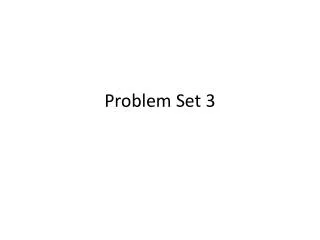
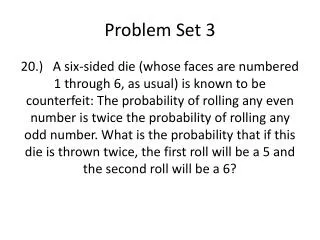
Problem Set 3 20.) A six-sided die (whose faces are numbered 1 through 6, as usual) is known to be counterfeit: The probability of rolling any even number is twice the probability of rolling any odd number. What is the probability that if this die is thrown twice, the first roll will be a 5 and the second roll will be a 6?
Since the first roll and second roll are independent events, we can use the Multiplication Rule: Let P(A)=the probability of rolling a 5 and P(B)=the probability of rolling a 6. Then
P(A) P(B)