Download
1 / 1
10 likes | 133 Vues
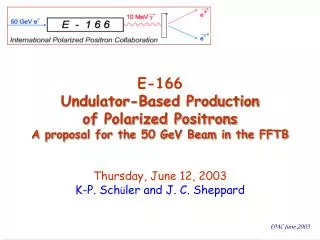
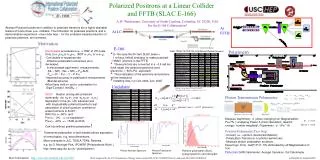
The E-166 collaboration at SLAC aims to demonstrate the production of polarized positrons alongside polarized electrons, which are crucial for future linear e⁺e⁻ colliders. This paper reviews the motivations behind utilizing polarized positrons in electroweak processes, highlighting the significance of enhanced polarization in the Giga-Z project and precision measurements. The experiment leverages a 50 GeV SLAC beam with a helical undulator to generate approximately 10 MeV polarized photons, which subsequently create polarized positrons. The study outlines methodologies for measuring polarization, essential for probing new physics.

E N D
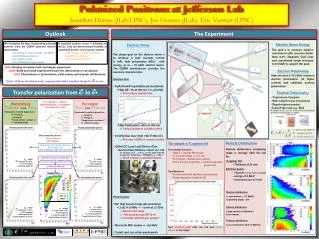
Polarized Positrons at a Linear Collider and FFTB (SLAC E-166) A.W. Weidemann, University of South Carolina, Columbia, SC 29208, USA For the E-166 Collaboration* AbstractPolarized positrons in addition to polarized electrons are a highly desirable feature of future linear e+e- colliders. The motivation for polarized positrons, and a demonstration experiment –now under way - for the undulator-based production of polarized positrons are reviewed. At FFTB: At LC: Motivation E-166 • Electroweak processes e+e- -> WW, Z, ZH ouple • Only to e-Le+R or e-Re+L (NOT e-Le+L or e-e+R). • Can double or suppress rate • -Effective polarization enhanced, error decreased, • in electroweak asymmetry measurements, • (NL – NR) / (NL + NR) = Peff ALR, • Peff = (P- - P+) / (1 – P-P+). • -Improved accuracy in polarization measurement • (Blondel scheme) • ►Must have both e+ and e- polarization for • Giga-Z project (sin2θW ) Polarimetry • E-166 uses the 50 GeV SLAC beam + • 1 m-long, helical undulator to make polarized ~10MeV photons in the FFTB. • These photons are converted in a ~0.5 rad.len. thick target into polarized positrons (and electrons). (~50% Pol. expected) • The polarization of the positrons and photons will be measured. • Installing now, run Oct. 2004, Jan. 2005 Undulator SUSY Slepton and squark produced dominantly via eR e+L (not eR eR or e LeL) Separation of the (LL, LR) selectron pair with longitudinally polarized beams to test association of chiral quantum numbers to scalar fermions in SUSY : With P(e-)= -80% and: P(e+)= 0% => no separation! P(e+)= -40% => 163fb vs 66 fb Can’t do without positron polarization! Photon Transmission Polarimetry: Measure Asymmetry d (when changing Iron Magnetization; Pe=7% ); analysing Power A (from calculation, Geant3; energy / number weighted), P(gamma)= d / (Pe * A) Positron Polarimetry:Two-Step: -Convert e+ ->photon (brems/annihilation); -Polarization Transfer e+ to photon well-known -Measure photon polarization as above. Expect sys. Error del(P)/P of~ 5% dominated by eff Magnetization of Iron. Detectors:Si/W Calorimeter; Aerogel Cerenkov, CsI Calorimeter Transverse polarization of both beams allows separation of new physics, e.g. extra dimensions. More examples in JLC, TESLA TDRs, Reviews, e.g. by G. Moortgat-Pick, (POWER [Polarizationat Work..) http://www.ippp.dur.ac.uk/~gudrid/power/) Photon Number Spectrum Photon Polarization Spectrum Positron polarization (blue), energy spectrum (red histogram More Information: http://www.slac.stanford.edu/exp/e166 Work supported by the U.S. Department of Energy under contract DE-AC03-76SF00515(SLAC) and grant DE-FG02-95ER40910. achim@SLAC.Stanford.EDU