Division by Convergence
This document explores advanced division algorithms, such as Division by Convergence and Reciprocation, focusing on their computational efficiency and practical implementation in hardware. It discusses how traditional division methods manipulate variables in cycles and emphasizes the speed-up techniques involving quadratic convergence. Key questions regarding multiplier selection, iteration counts, and hardware requirements are addressed. The findings underscore potential performance improvements, especially in applications requiring multiple divisions, utilizing Newton-Raphson iteration and precise hardware configurations.

Division by Convergence
E N D
Presentation Transcript
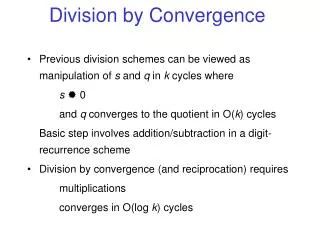
Division by Convergence • Previous division schemes can be viewed as manipulation of s and q in k cycles where s 0 and q converges to the quotient in O(k) cycles Basic step involves addition/subtraction in a digit-recurrence scheme • Division by convergence (and reciprocation) requires multiplications converges in O(log k) cycles
Division by Repeated Multiplication q =z/d =z/d x (0)/x (0)x (1)/ x (1) . . . x (m -1)x (m -1) q/1 To turn the above into a division algorithm, we face three questions: 1. How to select the multipliers x(I)? 2. How many iterations (pairs of multiplications)? 3. How to implement in hardware?
Division by Convergence Formulate as convergence computation, for d in [1/2, 1) d (i+1) = d (i) x (i) Set d (0) = d; make d (m) converge to 1 z (i+1) = z (i) x (i) Set z (0) = z; obtain z/d = q @ z (m) Q1: How to select the multipliers x(i)? x (i) = 2 – d (i) This choice transforms the recurrence equations into: d (i+1) = d (i) (2 – d (i)) Set d (0) = d; iterate until d (m)@ 1 z (i+1) = z (i)(2 – d (i)) Set z (0) = z; obtain z/d = q @ z(m)
Division by Convergence Q2: How quickly does d (i) converge to 1? d (i+1) = d (i) (2 – d (i) ) = 1 – (1 – d (i) )2 1 – d (i+1) = (1 – d (i) )2 Thus, 1 – d (i) £ e leads to 1 – d (i+1)£ e2 : quadratic convergence In general, for k-bit operands, we need 2m – 1 multiplications and m 2’s complementations where m = élog2kù
Quadratic Convergence ––––––––––––––––––––––––––––––––––––––----------------–––––––– i d(i) = d(i–1)x (i–1), with d (0) = d x (i) = 2 – d (i) –––––––––––––––––––––––––––––––––––––----------------––––––––– 0 1 – y = (.1xxx xxxx xxxx xxxx)two ³ 1/2 1 + y 1 1 – y2 = (.11xx xxxx xxxx xxxx)two ³ 3/4 1 + y2 2 1 – y4 = (.1111 xxxx xxxx xxxx)two ³ 15/16 1 + y4 3 1 – y8 = (.1111 1111 xxxx xxxx)two ³ 255/256 1 + y8 4 1 – y16 = (.1111 1111 1111 1111)two = 1 – ulp –––––––––––––––––––––––––––––––––––––––––––––– Note: 1/2 £ d = 1 – y < 1
Quadratic Convergence Q3: How implemented in hardware? … to be discussed later
To find q = z/d, compute 1/d and multiply it by z Particularly efficient if several divisions by d are required Newton-Raphson iteration to determine a root of f(x) = 0 Start with initial estimate x(0) for the root Iteratively refine using the recurrence x(i+1) = x(i) – f(x (i)) / f'(x (i)) Justification: tan a (i) = f'(x(i)) = f(x(i) ) / (x (i) – x (i+1) ) Division by Reciprocation
Division by Reciprocation To compute 1/d, find the root of f(x) = 1/x – d f'(x) = –1/x2, leading to the recurrence: x(i+1) = x(i) (2 – x(i)d) One iteration = 2 multiplications + a 2’s complementation Let d (i) = 1/d – x (i) be the error at the ith iteration. Then: d(i+1) = 1/d – x (i+1) = 1/d – x (i) (2 – x (i)d) = d(1/d – x (i))2 = d(d (i))2 Because d < 1, we have d(i+1) < (d (i))2
Choosing the Initial Value of x(0) 0 < x (0) < 2/d Þ | d (0) | < 1/d Þ guaranteed convergence For d in [1/2, 1): simple choice x (0) = 1.5 Þ | d x(0) | • 0.5 better approx. x (0) = 4(31/2 – 1) – 2d = 2.9282 – 2d max error @ 0.1
Speedup of Convergence Division Division can be done via 2 élog2kù – 1 multiplications This is not yet very impressive 64-bit numbers, 5-ns multiplier Þ 55-ns division Three types of speedup are possible: Reducing the number of multiplications Using narrower multiplications Performing the multiplications faster
Speedup of Convergence Division Convergence is slow in the beginning It takes 6 multiplications to get 8 bits of convergence and another 5 to go from 8 bits to 64 bits dx(0)x(1)x(2) = (0.1111 1111 . . .)two ----------- x(0+) read from table A 2w ´ w lookup table is necessary and sufficient for w bits of convergence after the first pair of multiplications
Example Example (64-bit multiplication) Table of size 256 ´ 8 = 2K bits for the lookup step Then we need multiplication pairs, with the multiplier being 9 bits, 17 bits, and 33 bits wide The final step involves a single 64 ´ 64 multiplication
Hardware Implementation z(i)x (i) can be pipelined with d (i)x (i) Must use other means for Reciprocation: Can begin with a good approximation to the reciprocal by consulting a large table or table lookup, along with interpolation
Analysis of Lookup Table Size Sample entries in the lookup table replacing the first four multiplications in division by repeated multiplications –––––––––––––––––––––––––––––––––------------–––––––– Address d = 0.1 xxxx xxxx x(0+) = 1. xxxx xxxx –––––––––––––––––––––––––––––––––––-------------––-––– 55 0011 0111 1010 0101 64 0100 0000 1001 1001 –––––––––––––––––––––––––––––––––--------------––––––– Example: d = 0.1001 1011 1, so value in range 311/512 £ d <312/512
Analysis of Lookup Table Size For 8 bits of convergence, the table entry f must satisfy 311/512 (1 + .f) ³ 1 – 2–8 312/512(1 + .f) £ 1 + 2–8 Thus 199/311 £ .f £101/156 or for the integer f = 256 ´ .f 163.81 £ .f £ 165.74 Two choices (address 55): 164 = (1010 0100)two or 165 = (1010 0101)two