Download
1 / 18
180 likes | 286 Vues
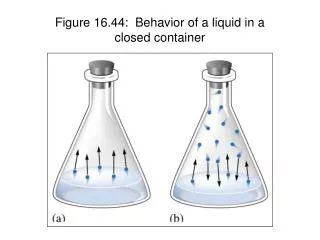
This document explores the behavior of liquids in closed containers, the relationship between molecular energy and kinetic energy at different temperatures, and the vapor pressure of various substances such as water, ethanol, and diethyl ether as functions of temperature. It includes detailed calculations of the heating process for 5 grams of water, covering phases from ice to steam, and presents the phase diagram of water alongside a hypothetical boiling point calculation under different atmospheric pressures.

E N D
Figure 16.47: The number of molecules in a liquid with a given energy versus kinetic energy at two temperatures.
Figure 16.48: The vapor pressure of water, ethanol, and diethyl ether as a function of temperature.
oK A liquid with ΔHvap=8.3145 J/mol boils on earth at 26.8 oC What is its boiling point on planet X with a pressure of 0.1 atmosphere?
Figure 16.50: The heating curve for a given quantity of water where energy is added at a constant rate. Let’s heat 5 grams of water from -20 oC to +150 OC This takes 5 steps
STEP 1: HEATING the ice: Specific heat capacity, sice = 2.1 J/g.oC Energy to raise 1 gram 1 degree q1 = 2.1 J/g.oC x 5 g x 20 oC = 210 J
STEP 2: MELTING the ice: Heat of fusion, ΔHfus = 6.01 kJ/mol q2 = 6.01x10³ J/mol x 5 g x (1mol/18.02g) = 1651 J
STEP 3: HEATING the water: Specific heat capacity, swater = 4.2 J/g.oC Energy to raise 1 gram 1 degree q3 = 4.2 J/g.oC x 5 g x 100 oC = 2100 J
STEP 4: VAPORIZING the water: Heat of vaporization, ΔHvap = 40.7 kJ/mol q4 = 40.7x10³ J/mol x 5 g x (1mol/18.02g) = 11181 J
STEP 5: HEATING the steam: Specific heat capacity, ssteam = 2.0 J/g.oC Energy to raise 1 gram 1 degree q5 = 2.0 J/g.oC x 5 g x 50 oC = 500 J