Understanding the Mean: A Guide to Calculating Averages
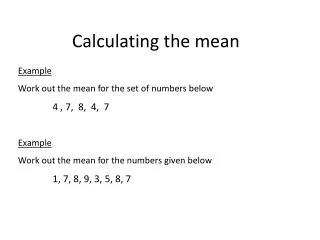
The mean is one of the three measures of central tendency, alongside the median and mode. It represents the average of a set of numbers and is calculated by dividing the sum of values by the total number of values. For example, for the set of numbers 10, 3, 11, 8, 15, and 13, we find the mean by summing them to get 60 and dividing by 6, resulting in a mean of 10. It’s important to note that the mean can be significantly affected by outliers, which is not the case for the median.

Understanding the Mean: A Guide to Calculating Averages
E N D
Presentation Transcript
Finding the mean of a set of numbers
A mean • is one of three types of average. • The others are the median and the mode. • The mean is the sum of the values divided by the number of values.
To find the mean we add the numbers and divide by 6. 10 + 3 + 11 + 8 + 15 + 13 = 60 The mean is 10 60 6 = 10
Notice that if we add 5 to each number10 3 11 8 15 13+ 5 become15 8 16 13 20 18
The mean of the new numbers increases by 5. 15 + 8 + 16 + 13 + 20 + 18 = 90 The mean is 15 15 90 6 =
Unlike the median the mean is influenced by extreme values. 10 3 11 8 15 13
If we replace 13 by 613. 10 3 11 8 15 613 13 The mean becomes 110.