Exploring Deductive Reasoning: Laws of Detachment and Syllogism in Logic
This text delves into the principles of deductive reasoning, focusing on the Law of Detachment and the Law of Syllogism. The Law of Detachment states that if a true conditional statement ("if p, then q") holds and p is true, then q must also be true. The Law of Syllogism allows one to conclude that if two conditionals are true, the first and last statements can be linked. Through various examples, this text demonstrates how to apply these laws to determine the validity of given conclusions.

Exploring Deductive Reasoning: Laws of Detachment and Syllogism in Logic
E N D
Presentation Transcript
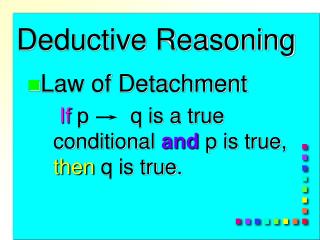
Deductive Reasoning • Law of Detachment • If p q is a true conditional and p is true, then q is true.
Law of Syllogism • If p q and q r are true conditionals, then p r is also true.
Determine if statement (3) follows from statements (1) and (2) by the law of detachment or the law of syllogism. If it does, state which law. (1) If a student is enrolled at GMAA, then the student has an uniform. (2) Hannie is enrolled at GMAA. (3) Hannie has an uniform. Yes; detachment.
(1) If your car needs more power, use Powerpack Motor Oil. (2) Marcus uses Powerpack Motor Oil. (3) Marcus needs more power in his car. no
(1) If you like pizza with everything, then you’ll like Jimmy’s Pizza. (2) If you like Jimmy’s Pizza, then you are a pizza connoisseur. (3) If you like pizza with everything, then you are a pizza connoisseur. Yes; syllogism
Determine if a conclusion can be reached from the two given statements using the law of detachment or the law of syllogism. If a conclusion is possible, state it and the law that is used. If a conclusion does not follow, state “No conclusion.” (1) If 2 angles form a linear pair, then they share a common ray. (2) If 2 angles share a common ray then they are adjacent.