Download
1 / 19
190 likes | 344 Vues
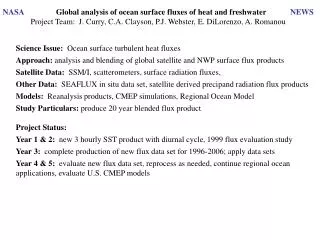
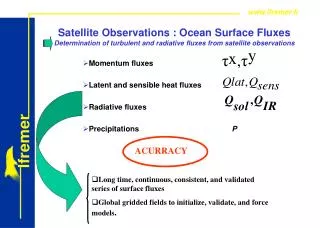
The OAFlux project provides comprehensive analysis of ocean surface heat fluxes based on data collected from 1981 to 2005. The study includes detailed assessments of latent and sensible heat fluxes, as well as longwave and shortwave radiations. Utilizing a combination of satellite retrievals, ship observations, and atmospheric reanalyses, the project identifies long-term trends in latent heat flux and establishes a relationship with global sea surface temperature variations. OAFlux is supported by NOAA and offers crucial insights into air-sea interactions in ice-free oceans.

E N D
Ocean Surface heat fluxes Lisan Yu and Robert Weller lyu@whoi.edu rweller@whoi.edu http://oaflux.whoi.edu
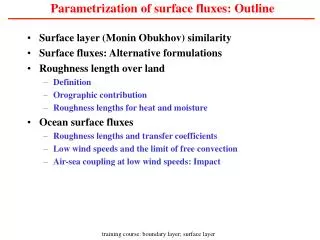
Ocean Surface heat fluxes • A brief introduction of the OAFlux project • Surface latent and sensible heat fluxes — the state of the latent and sensible heat fluxes in 2005 — its relation to 2004 and to the analysis record that starts from 1981 — the long-term trend in latent heat flux • Surface longwave and shortwave radiations (ISCCP) — time series of the global averaged long- and short-wave radiations (1984-2004) — Problems of the ISCCP datasets • Comparisons — mean pattern comparison with SOC, NCEP1, and ERA40 — time series comparison with buoy measurements
Objectively Analyzed air-sea Fluxes (OAFlux) website: http://oaflux.whoi.edu/ • The project is supported by NOAA Office of Climate Observation (OCO) and Climate Change and Data Detection (CCDD). PIs: Yu and Weller,withtechnical support from X.Jin • It is to develop gridded air-sea heat fluxes analysis for the global ice-free oceans for the past 50 years • The development is based on a weighted objective analysis that combines surface meteorology from satellite retrievals, COADS ship observations, and model outputs from atmosphere reanalyses. • Data currently available online: – Global QLH and QSH on daily/monthly and 1º-grid for the years 1981-2005. – Global QLW and QSW (1983-2004) are from ISCCP (Bill Rossow).
OAFlux: estimating QLH and QSH QLH = Le ce U (qs – qa) QSH = cp cp U (Ts – Ta) Four independent variables U, Ts, qa, and Ta. • Input Data Sources • Atmospheric reanalyses (NCEP/DOE and ERA40) • Air humidity and temperature at 2m, surface wind at 10m, SST, sea level pressure • Satellite retrievals: • SSMI wind speed and air humidity, AVHRR SST, TMI and AMSR-E SST, scatterometer winds Weighted Objective Analysis: produce optimal estimate for variable fields through combining data from various sources Best estimates of daily flux-related variable fields COARE bulk flux algorithm 3.0 (Fairall et al. 2003) Daily latent and sensible heat fluxes References regarding the methodology and validation: Yu, L., R. A. Weller, and B. Sun, 2004a: Improving latent and sensible heat flux estimates for the Atlantic Ocean (1988-1999) by a synthesis approach. J. Climate, 17, 373-393. Yu, L., R. A. Weller, and B. Sun, 2004b: Mean and variability of the WHOI daily latent and sensible heat fluxes at in situ flux measurement sites in the Atlantic Ocean. J. Climate, 17, 2096-2118. Yu, L., and R. A. Weller, 2006: Objectively Analyzed air-sea heat Fluxes (OAFlux) for the global ice-free oceans: Trend and variability during 1981-2005. Submitted to Bull. Amer. Meteor. Soc.
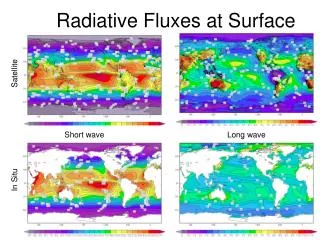
ISCCP Surface longwave and shortwave radiationsyearly-mean averaged over the global oceans
Effect on the EOF analysis The Atlantic Ocean
Problems in the ISCCP datasets(2) mean bias: QLW+QSW (1984-2002) Positive downward
TRITON heat fluxes at (1.5S, 90E) (H. Hase/IORGC) shortwave net sensible longwave latent OAFlux ISCCP (provided by Dr. Yoshifumi Kuroda)
Locations of in situ measurements All components No QLW x No QLW and QSW
Stratus buoy (693 days, 10/08/00 to 08/31/02) 30-day running mean applied Fluxes comparison statistic based on daily means ---------------------------------------------------------------------- QNETQLH+QSHQSW+QLW ---------------------------------------------------------------------- Buoys 50 -110 160 OAFlux&ISCCP 54 ( +4) -113 ( -3) 168 ( +8) NCEP1 -14 (-64) -144 (-34) 130 (-30) ERA40 47 ( -3) -124 (-14) 171 (+11) ---------------------------------------------------------------------- Statistics based on daily means
Pacific Basin: TAO array The meridionally averaged mean QSW (Sep.1991 – Aug.2002) for TAO array, ISCCP, ERA40, NCEP1 and NCEP2 as a function of longitude
Summary • The OAFlux product 1981-2005: a synthesis of satellite observations and NWP reanalyses outputs of surface meteorology. • Surface latent and sensible heat fluxes – There is a long-term trend in latent heat flux. The mean has increased by about 10Wm-2 since 1981, which amounts to almost 12% change. – The increasing trend in latent heat flux is in concert with the warming trend of global SST. • Surface longwave and shortwave radiations (ISCCP) — time series of the global averaged long- and short-wave radiations (1984-2004) — Problems of the ISCCP datasets: (1) spatial structure is affected by the mean drifts in different sensors (2) mean bias in the tropical oceans: Too much net downward QSW