Understanding Cellular Respiration: ATP Production in Living Organisms
Cellular respiration is the process through which all living organisms convert glucose into ATP molecules. This critical energy transformation can occur via two main paths: anaerobic respiration, which happens in the cytoplasm without oxygen (mainly in single-celled organisms), and aerobic respiration, using oxygen to produce ATP more efficiently. Glycolysis, the initial step in both processes, breaks down glucose into pyruvic acid, yielding ATP. Anaerobic processes like alcoholic and lactic acid fermentation produce minimal ATP, while aerobic respiration in mitochondria generates up to 36 ATP per glucose molecule.

Understanding Cellular Respiration: ATP Production in Living Organisms
E N D
Presentation Transcript
Cellular Respiration • Purpose: Create ATP molecules from Glucose! • Who uses this? ALL LIVING ORGANISMS. • Two Types: 1. Anaerobic Respiration: occurs in Cytoplasm *organisms do NOT use oxygen! *Inefficient for multicellular organisms. 2.Aerobic Respiration: cytoplasm and mitochondrion *organisms USE oxygen. *Efficient for multicellular organisms
GLYCOLYSIS • Glyco: sugar Lysis: dissolving • Process that breaks down GLUCOSE to obtain ATP molecules! • Occurs in the Cytoplasm • 1st step in BOTH Aerobic and Anaerobic Respirations. • NAD is an enzyme that picks up H and electrons
What happens during Glycolysis? • 2 ATPS are used to break glucose apart. 6 Carbon Glucose molecule is broken into 2 Pyruvic Acids (3 Carbon sugar) are created. 2. Net vs. Gross energy Process Made: 4 ATPS (Gross #) Used: 2 ATPS 4 – 2 = 2 ATPS (Net #)
Products of Glycolysis • From the break down of C6H12O6 (Glucose): • 2 Pyruvic Acids moves to the next chemical reaction. (either anaerobic or aerobic respiration) • 2 ATPs (NET #) • NADH (taxi-cab; transports H ions) moves to the next chemical reaction. (either anaerobic or aerobic respiration) Oxygen is available Aerobic Respiration occurs NO OXYGEN = Anaerobic Respiration occurs
Anaerobic Respiration • Steps: • Glycolysis: 2 ATPs made • Fermentation: 0 ATPS made • Both steps occur in the Cytoplasm This is why this organelle is the site of many chemical reactions! Who uses Anaerobic Resp. ? Bacteria, plants, fungus (yeast), and animals (muscle cells only)
ALCOHOLIC FERMENTATION • Yeast, plants and bacteria use this. 2. 0 ATP made; NAD is regenerated 2 Pyruvic Acids + 2 NADH 2 Ethanol (Alcohol) + 2 CO2 + 2 NAD
ALCOHOLIC FERMENTATION • Products made from alcoholic fermentation: • 2 NAD, 2 Ethanol, and 2 CO2 Food/Beverage Products made from this process: • Breads • Beer • Wine
Lactic Acid Fermentation 1. Fungus, plants, bacteria, and animal muscle cells use this. 2. 0 ATP made; NAD is regenerated Step: 2 Pyruvic Acids + 2 NADH 2 Lactic Acid + 2 NAD • Lactic acid builds up: In animals causes soreness of muscles. Lactic acid is shipped to liver and converted back into a sugar.
LACTIC ACID FERMENTATION • Products made from Lactic Acid Fermentation: • 2 NAD, 2 Lactic Acid Food Products made from this process: Yogurt Soy sauce Sauerkraut
Review of Anaerobic Respiration • Occurs in the cytoplasm • Steps: 1. Glycolysis: 2 ATPs 2. Fermentation: Lactic Acid or Alcoholic: 0 ATPs Inefficient: 2 ATPs/Glucose
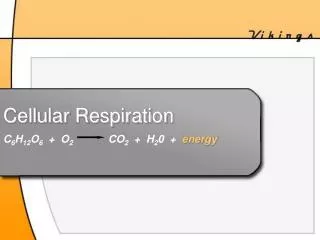
Aerobic Respiration • C6H12 O6 + 6 O2 6 CO2 + 6 H2O
Aerobic Respiration • Requires oxygen to make ATP. • Process begins in the cytoplasm and ends in a mitochondrion. • Makes 18X more ATP molecules than anaerobic respiration (36 in aerobic and 2 in anaerobic)
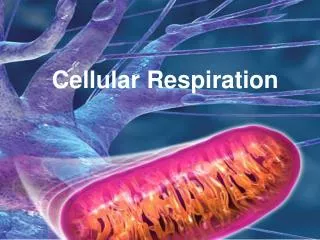
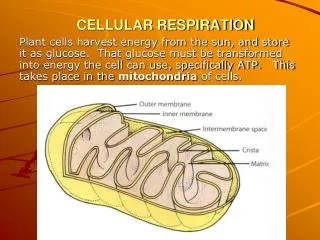
Structure of a Mitochondrion • Inner and outer membranes similar to the cell membrane • Matrix and Cristae
Steps of Aerobic Respiration • 1. Glycolysis: occurs in the CYTOPLASM Products: 2 Pyruvic Acids 2 ATP (net #), 2 NADH
Krebs Cycle (Citric Cycle) 2. Krebs cycle • Occurs in matrix of mitochondrion • Products: 2 ATPs Diagram in book: p. 227
Electron Transport Chain (ETC) • Occurs in the cristae of a mitochondrion • FADH2 and NADH enter and create: • 32 ATP • H2O • Carrier molecules (FAD and NAD) return to beginning of the cycle
Aerobic Respiration Products • Glycolysis: 2 ATPs • Krebs: 2 ATPs • ETC: 32 ATPs • TOTAL: 36 ATPs/Glucose. Carbondioxide, Water • How does this compare to Anaerobic?