Download
1 / 22
220 likes | 327 Vues
Discover the fascinating world of stars, from ancient history to modern classifications, life cycles, and different types. Learn about Yellow Dwarf, Red Giant, Neutron Stars, and more in this comprehensive guide.

E N D
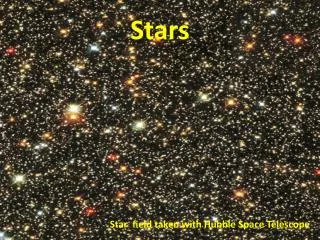
By: ADRIAN SEAN D. APARILLA Aaron Kyle R. Daug Environmental science Grade 6 - Neil Armstrong What is a star & how many different kinds are there?
Outline • Sean : • All About stars • Classifications • History • Descriptions • Life Cycle • Aaron : • Types of Stars • Definitions for every Star
An easy mnemonic for remembering these is: • O - oh • B - be • A - a • F - fine • G - girl • K - kiss • M - me
HISTORY • Ancient people: quadrant • 1584 : GiordanaBruno • Greek astronomers: Ptolemy and Hipparchus • 20th century
DESCRIPTIONS OF STARS • a luminous globe of gas • nebulae & consist of hydrogen and helium gas • 2000°C to above 30,000°C • brightest stars - 100 times that of the Sun • smallest mass for a star is about 8% that of the Sun
The different kinds of stars are: • Yellow dwarf stars • Orange dwarf stars • Red dwarf stars • Brown dwarfs • Blue giant stars • Red giant stars • Red super giant stars • White dwarfs • Black dwarfs • Neutron stars
Yellow Dwarf Stars (the sun, Alpha Centauri A, Kepler-22) • Lifetime: 4 - 17 billion years • Evolution: early, middle • Temperature: 5,000 - 7,300 °C • Spectral Types: G, F • Luminosity: 0.6 - 5.0 • Radius: 0.96 - 1.4 • Mass: 0.8 - 1.4 • Prevalence: 10%
Brown Dwarfs • Lifetime: unknown (long) • Evolution: not evolving • Temperature: 0 - 1,800 °C • Spectral Types: L, T, Y (after M) • Luminosity: ~0.00001 • Radius: 0.06 - 0.12 • Mass: 0.01 - 0.08 • Prevalence: unknown (many)
Orange Dwarf Stars(Alpha Centauri B and Epsilon Eridani) • Lifetime: 17 - 73 billion years • Evolution: early, middle • Temperature: 3,500 - 5,000 °C • Spectral Types: K • Luminosity: 0.08 - 0.6 • Radius: 0.7 - 0.96 • Mass: 0.45 - 0.8 • Prevalence: 11%
Red Dwarf Stars(Proxima Centauri, Barnard's Star and Gliese 581) • Lifetime: 73 - 5500 billion years • Evolution: early, middle • Temperature: 1,800 - 3,500 °C • Spectral Types: M • Luminosity: 0.0001 - 0.08 • Radius: 0.12 - 0.7 • Mass: 0.08 - 0.45 • Prevalence: 73%
Red Supergiant Stars (Betelgeuse and Antares) • Lifetime: 3 - 100 million years • Evolution: late • Temperature: 3,000 - 5,000 ºC • Spectral Types: K, M • Luminosity: 1,000 - 800,000 • Radius: 100 - 1650 • Mass: 10 - 40 • Prevalence: 0.0001%
Blue Giant Stars(Rigel) • Lifetime: 3 - 4,000 million years • Evolution: early, middle • Temperature: 7,300 - 200,000 °C • Spectral Types: O, B, A • Luminosity: 5.0 - 9,000,000 • Radius: 1.4 - 250 • Mass: 1.4 - 265 • Prevalence: 0.7% hubpages.com
Red Giant Stars(Aldebaran and Arcturus) • Lifetime: 0.1 - 2 billion years • Evolution: late • Temperature: 3,000 - 5,000 °C • Spectral Types: M, K • Luminosity: 100 - 1000 • Radius: 20 - 100 • Mass: 0.3 - 10 • Prevalence: 0.4%
White Dwarfs(Sirius B and Van Maanen'sstar) • Lifetime: 1015- 1025 years • Evolution: dead, cooling • Temperature: 4,000 - 150,000 ºC • Spectral Types: D (degenerate) • Luminosity: 0.0001 - 100 • Radius: 0.008 - 0.2 • Mass: 0.1 - 1.4 • Prevalence: 4% hubpages.com
Black Dwarfs • Lifetime: unknown (long) • Evolution: dead • Temperature: < -270 °C • Spectral Types: none • Luminosity: infinitesimal • Radius: 0.008 - 0.2 • Mass: 0.1 - 1.4 • Prevalence: ~0%
Neutron Stars • Lifetime: unknown (long) • Evolution: dead, cooling • Temperature: < 2,000,000 ºC • Spectral Types: D (degenerate) • Luminosity: ~0.000001 • Radius: 5 - 15 km • Mass: 1.4 - 3.2 • Prevalence: 0.7%
References & Sources:> kidsastronomy.com> Wikipedia, the free encyclopedia> en.wikipedia.org> www.space.com> www.universetoday.com> hubpages.com> http://www.universetoday.com/25156/history-of-stars/#ixzz38l9lLV4U> http://planetquest.jpl.nasa.gov/science/science_index.cfm> http://cosmology.carnegiescience.edu/timeline/1838>www.google.com.ph/search?q=LIFE+CYCLES+of+stars+ASTRONOMY&tbm=isch&ei=tTLWU8fhKIL48QWapIFA#facrc=_&imgdii=Uqcwn9o5Dk63TM%3A%3B5i7DEMwbIdTJ8M%3>www.google.com.ph/search?q=description+of+stars+ASTRONOMY&source=lnms&sa=X&ei=icbWU9LqI4yl8AWcgoHQCA&ved=0CAUQ_AUoAA&biw=1280&bih=699&dpr=1