Download
1 / 1
10 likes | 160 Vues
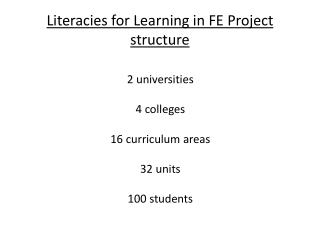
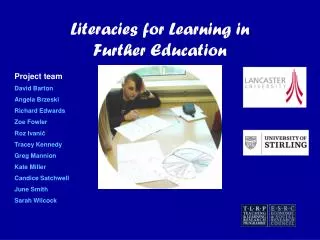
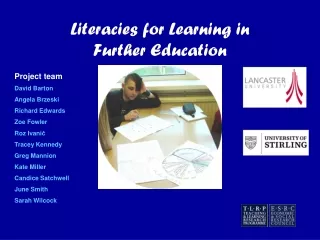
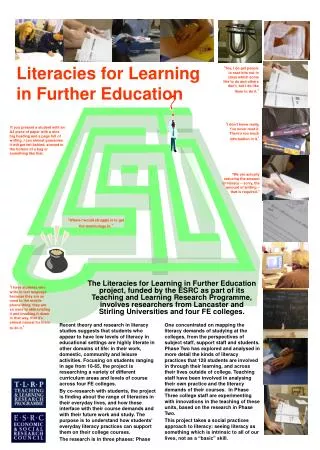
In the context of the Literacies for Learning in Further Education project, educators express diverse attitudes towards student engagement with literacy. Some support oral reading, while others see traditional texts as ineffective. The challenge lies in presenting information in accessible formats to prevent disengagement. Many students, accustomed to text language from mobile communication, struggle with conventional writing styles. This project, a collaboration between Lancaster and Stirling Universities and four FE colleges, aims to explore how literacy can be adapted to better suit modern learners' needs.

E N D
‘Yes, I do get people to read bits out in class which some like to do and others don’t, but I do like them to do it.’ Literacies for Learning in Further Education ‘I don’t know really, I’ve never read it. There’s too much information in it.’ ‘If you present a student with an A4 piece of paper with a nice big heading and a page full of writing, I can almost guarantee it will get left behind, shoved in the bottom of a bag or something like that. “We are actually reducing the amount of literacy – sorry, the amount of writing – that is required.” ‘Where I would struggle is to get the terminology in.’ The Literacies for Learning in Further Education project, funded by the ESRC as part of its Teaching and Learning Research Programme, involves researchers from Lancaster and Stirling Universities and four FE colleges. ‘I have students who write in text language because they are so used to the mobile phone thing, they are so used to abbreviating it and breaking it down in that way, that it’s almost natural for them to do it.’