Download
1 / 33
330 likes | 451 Vues
Learn about literacy practices in FE project structures across universities and colleges, focusing on workplace, assessment, and learning aspects. Discover how literacy practices can overlap in real work environments and educational settings.

E N D
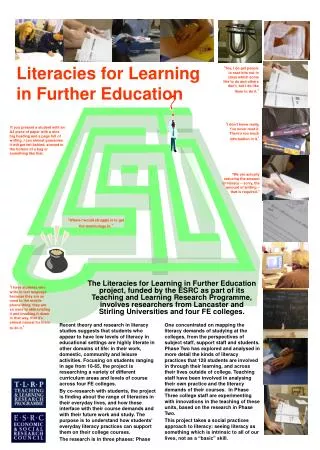
Literacies for Learning in Further Education Research Project From Plumbing to Punctuation:What do we mean by ‘embedded’? North West SfL Research ForumLancaster University7 June 2006
LfLFE Research Project www.lancs.ac.uk/lflfe/
Literacies for Learning in FE Project structure 2 universities 4 colleges 16 curriculum areas 32 units 100 students
Lancaster University University of Stirling Lancaster and Morecambe College Preston College Anniesland College Perth College Child Care Catering & Hospitality Travel & Tourism Media Studies Certificate in Child Care and Education Diploma in Child Care and Education NVQ 1 Intro to C&H NVQ 2 Food and Drink Service Working Overseas BTEC ND Travel & Tourism AS Media Studies Access to HE: Media Studies Level 2 Level 3 Level 1 Level 2 Level 2 Level 3 Level 3 Level 2 Four students Four students Four students Four students Four students Four students Four students Four students
Categories of literacy practices in learning vocational subjects in Further Education • Literacy practices for learning (e.g. reading and making notes from a text book) • Literacy practices for assessment (e.g. producing an essay or a report) • Evidence-providing literacy practices (e.g. completing a log book or portfolio) • Literacy practices relating to the workplace (e.g. writing food orders; reading to children)
Literacy practices in the workplace (a Real Work Environment)
Literacy practices in the workplace (interactive literacies)
Texts in Catering and Hospitality • The following 11 slides represent some of the texts with which students interacted during ONE session in the restaurant at Lancaster and Morecambe College. • These texts all involved the students reading and/or writing in the course of working in the restaurant. • Almost all of these texts are similar to those they would use in a “real” workplace – with some notable exceptions.
Methods for collecting data pertaining to FE students’ literacy practices outside college include: • The ‘clock activity’ to give an overview of students’ activities over a 24-hour period. • Student-taken photographs, representing literacy-related activities during one week. • Individual or group interviews leading on from the clock activities and/or the student-taken photographs. • Possible observation of, or other data related to, students during an out-of-college activity, e.g. at work, at a club, or at home.
Paul’s Home Literacies Works as a nightclub DJ: ‘my girlfriend bought me some decks … she bought me two or three records a week and then I started collecting them’ ‘I do it on my mate’s computer, go on certain websites… He gets us on, I just pick my vinyl’ Calculates how much entrance fees to charge: ‘I got my mum to do that because I can’t do maths…’ Designs flyers to advertise his DJ functions: ‘I got a lad at the University at Preston to do it.’ Owns property: ‘the house that I am in at the moment with my dad, I own I think it’s a quarter of it, I gave him a lump sum towards that.’ ‘we’ll buy that, do that up and then hopefully sell it.’ Does things with his partner’s children: ‘Yeah I do a lot of reading with the kids.’ ‘We got a cornflake box, cut it out and made wheels and that … from a plan …she had to write it in and then I had to write underneath…’
Increasing resonance between home and pedagogic literacy practices To be more congenial to the “Pauls” who are trying to obtain a qualification: • Resonance may be encouraged by offering 1:1 help with portfolio building or even introducing ‘study buddies’; • The requirements for ‘demonstrating competence’ might be brought more in line with the literacy demands of the industry.
Workplace and home literacy practices Mostly multi-modal Mostly multi-media Shared, interactive, participatory Non-linear Agentic Purposeful Clear audience Generative Pedagogic literacy practices Mostly mono-modal Mostly paper-based Individual, non-interactive, solitary Linear Non-Agentic Ambiguous purpose Ambiguous audience Information provided Comparison of workplace, home and pedagogic literacy practices