Midterm 1 Review: Counting Principles and Number Theory Overview
This review covers key concepts from Midterm 1, focusing on Counting Principles and Number Theory. In Part I, we delve into fundamental counting techniques including the Sum and Product Principles, Bijection Principle, and methods of counting objects like lists, functions, and permutations. Part II shifts to Number Theory and Cryptography, exploring modular arithmetic, the GCD, and the Extended GCD algorithm. Gain insights into ensuring secure e-commerce through these mathematical principles as you prepare for your midterm.

Midterm 1 Review: Counting Principles and Number Theory Overview
E N D
Presentation Transcript
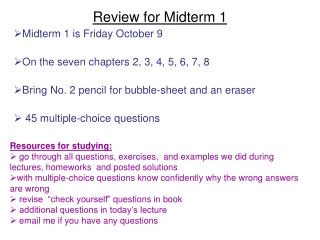
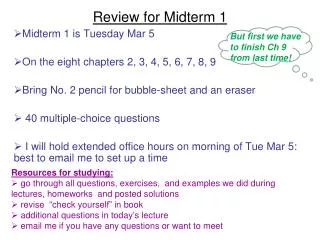
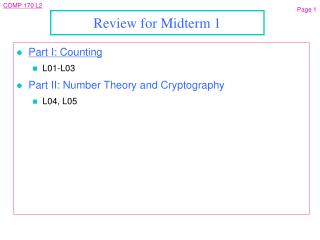
Review for Midterm 1 • Part I: Counting • L01-L03 • Part II: Number Theory and Cryptography • L04, L05
Why counting? Counting
Principles • Sum principle, Product Principle, Bijection Principle Objects to count • Lists, functions, subsets, permutations, partitions Counting Overview
Product Principle Si and Sj are disjoint, |Si| = n S = S1 U S2 U … U Sm |S| = m |Si| = mn
Principles • Sum principle, Product Principle, Bijection Principle Objects to count • Lists, functions, permutations, subsets, partitions Counting Overview
Counting Permutations • Number of k-element permutations • Number of permutations of a set of size n
Page 14 Counting Subsets
Avoid Double Counting Exco Members: Year 1: 4; Year 2: 5; Year 3: 3 • WRONG ANSWER: • First choose 1 from each year • Then pick 3 from remaining 9 members • Answer
Review for Midterm 1 • Part I: Counting • L01-L03 • Part II: Number Theory and Cryptography • L04, L05
Part II of Course: Objective • Show how to make e-commerce secure using Number theory. • Three logic lectures: L04-L06 • L04-05 covered in Midterm 1
Addition and multiplication mod n • Basic properties Multiplicative inverse • GCD • Extended GCD algorithm Introduction to cryptography L04-L05 Overview
Proved: Euclid’s Division Theorem • Proof technique • Proof by contradiction • Proof by smallest counter example
Addition and multiplication mod n • Basic properties Multiplicative inverse • GCD • Extended GCD algorithm Introduction to cryptography L04-L05 Overview
a has multiplicative inverse in Zn iff gcd(a, n) =1 In that case, inverse of a = x mod n. Multiplicative Inverse
Addition and multiplication mod n • Basic properties Multiplicative inverse • GCD • Extended GCD algorithm Introduction to cryptography L04-L05 Overview