Download
1 / 17
170 likes | 284 Vues
This evaluation design focuses on the "Communities on the Move" approach, aimed at improving physical activity levels among socially disadvantaged groups in the Netherlands. The study examines the effectiveness and cost-effectiveness of community-based physical activity programs from individual, group, program, and community perspectives. Key principles include active participation, social networking, and fun in physical activity. Results aim to inform strategies for reducing health inequities and enhancing the well-being of low socioeconomic status populations.

E N D
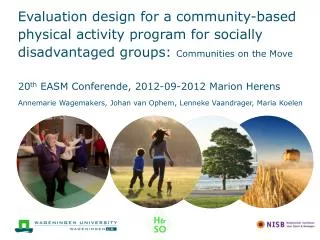
Evaluation design for a community-based physical activity program for socially disadvantaged groups: Communities on the Move 20thEASM Conferende, 2012-09-2012Marion Herens Annemarie Wagemakers, Johan van Ophem, Lenneke Vaandrager, Maria Koelen
Content • Trend in physical activity • Rationale Communities on the Move approach (CoM) • Key principles of CoM • Research aims (cost)effectiveness CoM • Research questions • Evaluation design CoM
Physical activity in the Dutch adult population 2000-2009 (Hildebrandt et al, 2010) Figure 1 Persons (%) of 18 years of age and older meeting the Dutch Healthy Physical Activity guidelines
Rationale CoM • Persistent health and physical activity inequalities despite policy actions and active health and physical activity promotion in the Netherlands (Van der Lucht et al, 2010; Van Oort et al, 2004) • Inactivity among Dutch adults stabilises since 2005 (5,5 %). Groups not meeting guidelines generally people in poor(er) socio-economic conditions (Hildebrandt et al, 2010) • Physical inactivity has been identified as the fourth leading risk factor for global mortality by WHO causing an estimated 3.2 million deaths globally (WHO-GAPA, 2012)
Environment Fun being active active Social network Principle based approach: Seven key principles matter... Participant level: • socialnetwork approach: findpeoplewherethey meet • activeparticipation: participants part of decision making • Fun factor: the fun of beingactiveandplay • Involvement of socialandphysicalenvrionment Organisational level: • Group coaching • Intersectoral collaboration & networks • Localsustainability
Human ecology CoM Implemeningorgansisation CoM Community CoMgroup
Research aims • Overall: Development of a context-sensitive monitoring and evaluation approach in order to measure the effectiveness and cost-effectiveness of community-based physical activity programs at distinct impact levels: individual, group, program, and communityBased on: ”What is it about this approach that works, for whom, in what context, and why?”(Pawson & Tilly, 1997) • Test the design in the field through action research Challenge to develop a research approach which has both practical and scientific relevance
Research questions (1) Specific research questions: • Individual level - Which effects can be documented with respect to physical activity behaviour and health, quality of life and life satisfaction? • Group level – How do active participation and group learning support behavioural change with respect to changes in physical activity and habitual behaviour?
Research questions (2) • Program level - Which mechanisms explain the successes and failures of Communities on the Move? • Overall - How can results be interpreted in terms of costs and benefits and what combination of economic evaluation methods and tools is most appropriate to evaluate a community-program on cost-effectiveness?
Study design effectiveness and cost-effectiveness of CoM Multiple case study • Cohort – 16 groups/locations; monitored 18 months, 4 moments of measurement (t0-t3) Multi level • quantitative data collection (measurements and questionnaires) at participant level (min. n=240) • qualitative data collection at group, community and organisational level (interview, focus group, document analysis) • 4 locations in depth study (interview, focus group, observation, document analysis)
Outputs of the (cost)effectiveness study of CoM Overall: Recommendations for improving the health of low SES groups through physical activity. Further research results include: • An elaborated monitoring and evaluation design for participatory community health and physical activity promotion • Assessment of CoM’s (cost-) effectiveness at the individual, program, and community level • The facilitation of wider implementation of CoM at both national and local level
Challenges • Feasibilitycomprehensiveinterventionand research approach: making practiceand research worktogether • Combining M&E paradigms: results, learning & reflectionorientation • Tools and research strategydevelopment in relationto target groupsandtheircompetences
References • Hildebrandt VH, Chorus AMJ, & Stubbe JH (2010) Trendrapport bewegen en gezondheid 2008/2009. 2010, TNO Kwaliteit van Leven Leiden. • WHO-Global AdvocacyforPhysicalActivity (2012) Position Statement #2 Support for the inclusion of a global target on physicalinactivity, GAPA. 2012, WHO - GAPA. • Van Oort FVA, van Lenthe FJ, & Mackenbach JP (2004) Co-occurrence of lifestyle risk factors and the explanation of education inequalities in mortality: results from the GLOBE study.PreventiveMedicine, 39(6), 1126-1134. • Van der Lucht F, Polder JJ (2010) Van gezond naar beter; Kernrapport van de Volksgezondheid Toekomstverkenning. 2010, Rijksinstituut voor Volksgezondheid en Milieu (RIVM), Bilthoven. • PawsonR & TilleyN (1997) Realistic evaluation, Thousand Oaks, CA US: Sage Publications, Inc.
Thank you for your attention Marion Herens PhD Candidate M: 06 31753714 T: +31(0)317 483670 E: marion.herens@wur.nl www.hso.wur.nl Project supervision: Maria Koelen, Annemarie Wagemakers, Johan van Ophem, Lenneke Vaandrager