Download
1 / 35
360 likes | 538 Vues
Explore the three states of matter—solid, liquid, and gas—understand their properties and behaviors. Learn about the kinetic theory of matter and how temperature affects particle motion. This chapter reviews the concept of melting points and freezing points, illustrated through common examples like water and the behavior of molecules at different temperatures. Discover why some substances are solids, others are liquids, and some are gases, along with insights into crystalline and non-crystalline solids. Dive into the fascinating transitions of matter in everyday life! ###

E N D
Chapter 4States of Matter Section 4-1 Solids
Everyday, water changes from a solid to a liquid to a gas and back again How can we explain this?
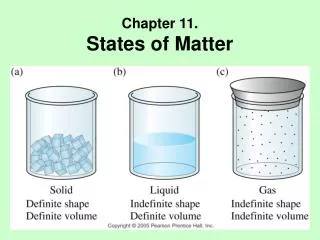
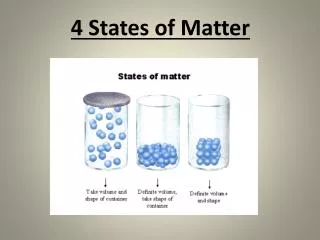
Let’s do a quick review of what you already know: • Matter has three states: • Solid • Liquid • Gas Matter is anything that takes up space and has mass.
More review • Most matter is made up atoms and molecules. • An atom is the smallest particle that makes up a given element of matter. • When two or more atoms combine, they make a particle called a molecule.
O H C O H H H C H Liquid Glucose Blood sugar O Solid O C H H O C H Water H C H O H Gas C N N H H O Nitrogen H Examples of molecules
??? • Why is water a liquid, nitrogen a gas and glucose a solid? • What makes a solid a solid? a liquid a liquid? a gas a gas?
One clue to this mystery was first reported in 1827 by scientist Robert Brown – • Brownian Motion
Under a microscope, dust particles can be seen to move in a random, jerky way.
The water molecules surrounding the dust particle are in constant, random motion. • When they hit the dust particle, they push it in random directions
Matter in motion • The idea that the particles (atoms and molecules) of all matter are in constant, random motion is called the kinetic theory of matter.
Kinetic Theory of Matter • All matter is made of atoms and molecules. • These particles are always in motion. • The higher the temperature, the faster the particles move. • At the same temperature, heavier particles move slower and lighter particles move faster.
Temperature and Heat • What makes hot tea different from cold iced tea? • Same particles • movement of particles is different • Higher temp = faster moving particles
Temperature and Heat • Lower the temperature and the particles slow down. • At very low temperatures the motion of the molecules is very slow. • You cannot make things so cold that the motion completely stops, but . . .
scientists have come close. The temperature at which the particles of matter would completely stop is called absolute zero.
Absolute zero is - 273.15° C You can’t get colder than that, no matter how hard you try
Transfer of heat • When hot matter touches colder matter, faster moving particles collide with slower moving particles. • The faster moving particles give some of their energy to the slower moving particles.
Matter in the solid state • In a solid, the particles vibrate or shake back and forth • but do not move from their position in respect to each other.
Crystals or Crystalline Solids • Particles of crystals are arranged in repeating geometric patterns
Diamond, a form of carbon, is also a crystalline solid. • the crystals are shaped something like pyramids.
Non-crystalline solids • Many solids do not form crystals. • Their molecules do not arrange into repeating patterns • often because they are too large. • Examples: • glass • many plastics
How does a solid become a liquid? • Start with very cold ice and gradually heat it. If you could see the molecules, you would see each molecule shaking faster and faster, • but still held in one position by the other molecules around it.
Keep heating your ice • When the temperature reaches 0° C, the molecules begin to break free. • The molecules begin to move freely around each other. • The molecules enter the liquid state.
Melting point = the temperature at which a substance changes from a solid to a liquid.
Temperature (C°) 60° 20° 0° -20° 0 Heat (kilojoules)
Temperature (C°) 60° 20° 0° -20° 0 Heat (kilojoules)
The amount of heat required to melt 1 kg of a solid is called its heat of fusion measured in kilojoules per kilogram kJ/kg
heat of fusion Temperature (C°) 0° Heat (kilojoules)
Water’s heat of fusion is 334 kJ/kg • That is the same amount of energy you would spend if you climbed all the stairs in a 110-story tall building. No, not a 110-foot tall building . . . a 110-story building!
Freezing • As you know, if you can melt something, you can cool the liquid again to freeze it. • When you cool a liquid, the particles begin to slow down. • The attractive forces between the particles begin to catch the particles, and crystals begin to form.
Freezing point = • the temperature at which attractive forces trap particles in a cooling liquid and form crystals. Think: If the melting point of iron is 1,535° C, at what temperature does iron freeze?
Non-crystalline solids • Non-crystalline solids, like glass, butter or wax, do not have a definite freezing or melting point. • If you slowly heat cold butter, it gradually gets softer and softer until it is completely liquid.