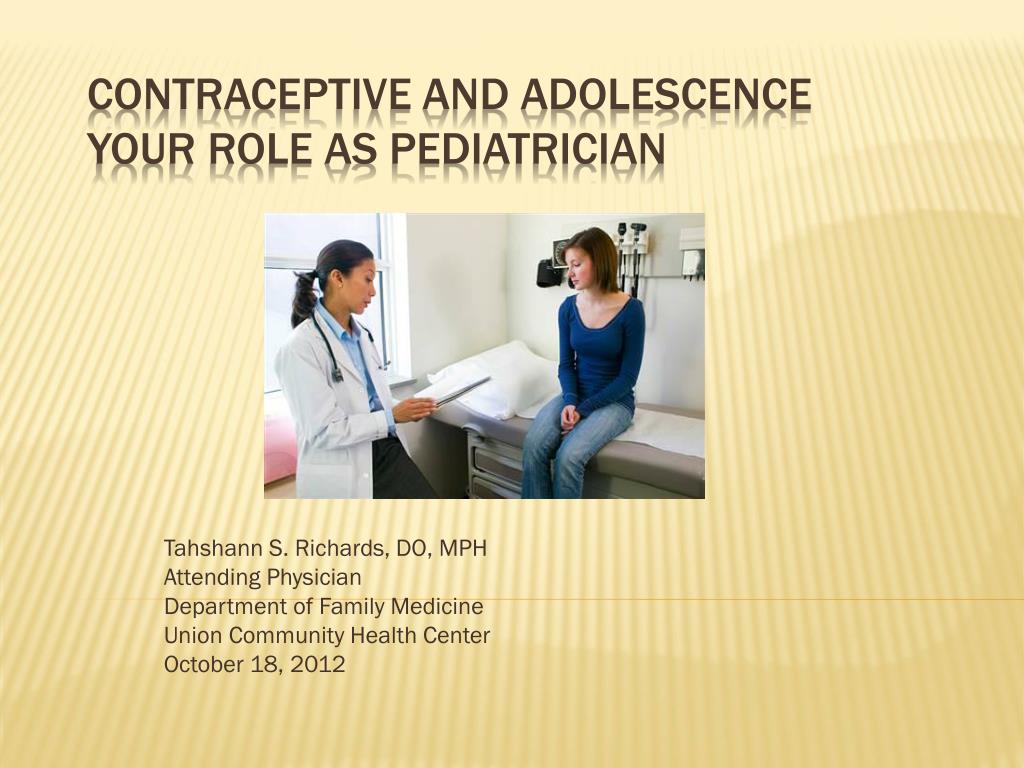
Tahshann S. Richards, DO, MPH Attending Physician Department of Family Medicine Union Community Health Center October 18, 2012 Contraceptive and AdolescenceYour Role As Pediatrician
National Youth Risk Behavior Study • 47.4% of students had ever had sexual intercourse • 33.7% of students had sexual intercourse with at least one person during the 3 mo before the survey (currently sexually active) • 6.2% of he students had sexual intercourse for the first time before 13 years old • 15.3% had sexual intercourse with ≥4 persons during their life
National Youth Risk Behavior Study • Among 33.7% sexually active students reported that during their last sexual encounter they or their partner had used the following: • Condom (60%) • Birth control pills (18%) • Injectable birth control, birth control ring, or intrauterine device (IUD) (5.3%) • Condom plus any of the above (9.5%)
82% of adolescent pregnancies are unplanned • Accounts for 1/5 of all unintended pregnancies in the US • 106 Bronx teens / 1,000 get pregnant • 30% more than the national rate • about 2x frequency in Staten Island • Teen births -4 per 1,000 in the Bronx • 2x rates in Queens and Manhattan
Start the talk early!! • Preadolescence • Puberty • Provide health info to preteens and family • Adolescence • Attitudes/knowledge about sex • Sexual activity • Use of contraception
Talking about contraceptive DOES NOT: • Increase rate of sexual activity • Reduce the age of coitarche • Increase number of sexual partners • Increase sexual experimentation
Promote healthy and responsible sexual decision making (including abstinence) Be supportive and non-judgmental Good history taking Careful listening KISS (Keep it Simple Silly) method
Know Teens Rights • When is confidentiality waived? • Guidelines for reimbursement for services • Medical record access • Appointment scheduling • Office policy regarding information disclosure
For sexually active teens using contraceptives • Support compliance • Manage side effects • Change method of contraception accordingly • Provide referral and frequent follow up • Counsel and screen periodically for STIs
Abstinence • Most effective • Delay initiation of sexual activity until adulthood • Efficacy of abstinence based education controversial
Condoms • Mechanical barrier method • Reduce transmission of STDs; therefore NOT optional • Pros • Easily accessible • No Rx required • Inexpensive • Legally purchased by minors • Young men share responsibility for contraception
Female condoms • Barrier method • Effective in prevention of STDs • Cons • Costly • Limited accessibility • Difficult to insert • Squeaks
Spermicides • Contains nonoxynol 9 and octoxynol 9 • High contraceptive failure rate when used alone • Effective in reducing pregnancy and STDs when used with condoms • Efficacy comparative to OCPS if used with condoms • Pros • No Rx required • Inexpensive
Oral Contraceptive Pills (“The Pill” or OCPs) • Monophasic (Ortho Cyclen), Multiphasic (Ortho TriCyclen, Loestrin) • Best for teens who: • Desire regular menses • Motivated and organized to take pill every day • Condom must be used to protect against STI
OCPs • Pros • Helps dysmenorrhea • Regulates menses • Treat DUB • Decrease risk of osteoporosis • Treat Acne • Protection against: • Ovarian and endometrial CA • Ectopic pregnancy • Ovarian Cysts • Iron deficiency anemia • Benign breast disease
OCPs • Quick start • Gyn exam and PAP (if indicated ) within next 3 mo • Frequent follow up and monitoring
Enhance compliance with patient education and problem solving • If teens miss 1–2 pills: • Take a pill as soon as pt remembers • Take the next pill at the usual time • If teens miss 3 or more pills: • Do not finish pack • Throw away remaining pills • Start next pack
Depo Provera (“The Shot”) • Medroxyprogesterone Acetate) • Long acting progestin • Suppresses ovulation • Thickens cervical mucus • Creates a thin, atrophic endometrium • Given 150 mg IM dose every 12 weeks • Best for teens who: • Chronic illness (sickle cell, seizures, MR) • Are lactating • At risk for complication with estrogen • Pts who do not remember to take pills
Depo Provera • Pros • Protection against endometrial cancer and iron deficiency anemia • Convenient • Effective pregnancy prevention • Cons • Irregular menses • Need for injection • Side effects- weight gain, headaches, bloating, depression and mood changes • Associated with delayed return to fertility • Possibly reversible osteopenia
Nuvaring (“The Ring”) • Combined hormonal ring • Etonogestrel and Ethinyl estradiol • Inserted once a month • Stays in vagina for 3 weeks • Must be removed 21 d after insertion • New ring is inserted 7 d later
Ortho Evra Patch (“The Patch) • Norelgestramin/ethinyl estradial • Transdermal • Change once a wk • Avoid placing on breast • Pros • Easy to remember • Effective • Cons • Increased risk of thromboembolic events • Not flesh colored
Long Acting Reversible Contraception (LARC) • Pros • Safe, Effective • Higher continuation rate (LARC 86% vs short acting 55%) • Decrease unintended pregnancy rate (22x higher for short acting contraceptives vs LARC) • Barriers • Inaccessible • The provider!
Intrauterine Device (IUD) • Mirena (Levonorgestrol) • Reversible • Protection up to 5 years • Expulsion rate range from 5-22 % • Changes in menstrual bleeding esp. in 1st month
Implant (Implanon, Etonogestrel) • Reversible, up to 3 years • High rates of infrequent bleeding or amenorrhea • Higher hemoglobin levels • Reduction in dysmenorrhea and pelvic pain • Minimal or no weight gain
Emergency Contraceptive Pills (Plan B) • Levonorgestrel • Progestin only pill • Effective up to 72 hrs after sex • Pregnancy test done before administration of pills and 3 weeks after administration to detect • Rx required for <18 yrs old • Provide refill for future use
Follow Up • Annual Pap • Screen for STIs every 6 mo-1 yr • Follow up Quarterly (sooner when initiating contraceptives) • CONDOMS, CONDOMS, CONDOMS…
References ACOG. Adolescents and Long-Acting Reversible Contracpetion: Implants and Intrauterine Devices. Number 539. October 2012 CDC. Youth Risk Behavior Surveillance Unite dstates 2011. MMWR vol 62. no 4 June 2012 AAFP. Managing Adverse Effects of Hormonal Contraceptiin Am Fam Physician 15:82 (12) 1499-1506. December 2010 AAP. Contrapception and Adolescents. Pediatrics Vol 104 No. 5 November 1999 http://www.nydailynews.com/opinion/astronomical-bronx-teen-pregnancy-rate-cries-action-article-1.979415#ixzz29dxRv5B8