Une image / un lien ci-dessous est fourni (tel quel) pour télécharger la présentation
Politique de téléchargement : le contenu du site vous est fourni TEL QUEL pour votre information et votre usage personnel ; il ne peut être vendu, concédé sous licence ni partagé sur d’autres sites sans l’accord de son auteur.Le contenu vous est fourni TEL QUEL, pour votre information et votre usage personnel uniquement.Téléchargez la présentation en cliquant sur ce lien.Lors du téléchargement, si vous ne parvenez pas à télécharger une présentation, l’éditeur a peut-être supprimé le fichier de son serveur.Pendant le téléchargement, si vous ne parvenez pas à obtenir une présentation, le fichier a peut-être été supprimé par l’éditeur.
F I N
Plus de contenu associé
Transcription de la présentation
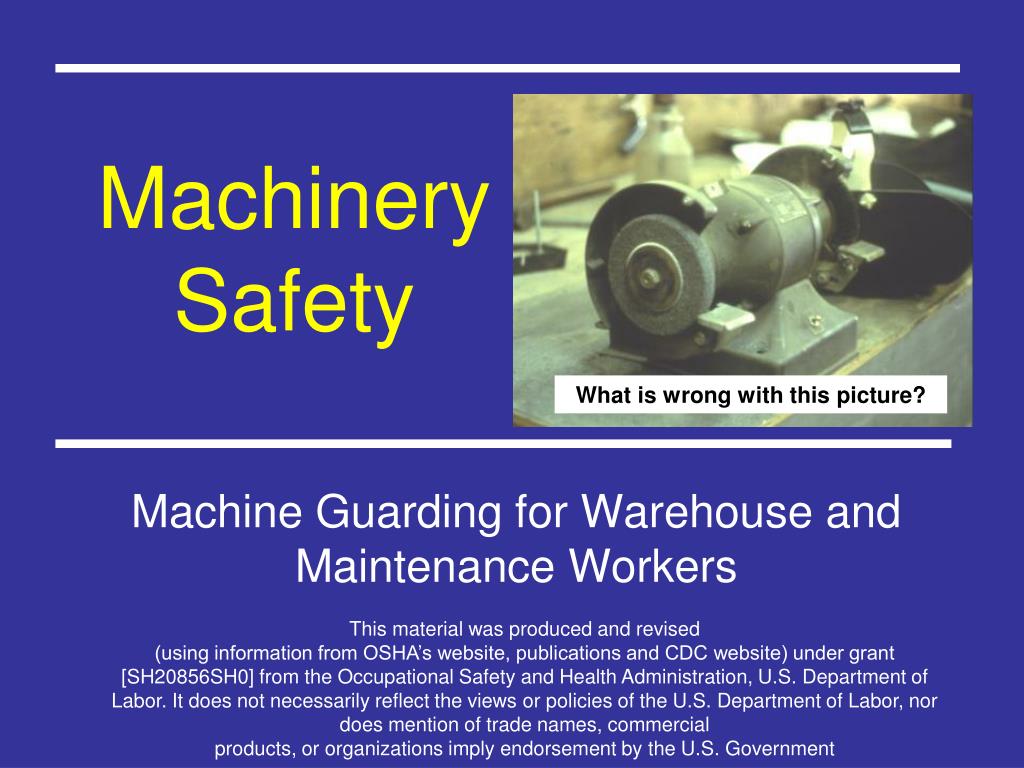
Machinery Safety What is wrong with this picture? Machine Guarding for Warehouse and Maintenance Workers This material was produced and revised (using information from OSHA’s website, publications and CDC website) under grant [SH20856SH0] from the Occupational Safety and Health Administration, U.S. Department of Labor. It does not necessarily reflect the views or policies of the U.S. Department of Labor, nor does mention of trade names, commercial products, or organizations imply endorsement by the U.S. Government
Mechanical power presses Power press brakes Powered and non-powered conveyors Printing presses Roll-forming and roll-bending machines Shearing machines Food slicers Meat grinders Meat-cutting band saws Drill presses Milling machines Grinding machines The Problem: Machinery Associated with Amputations
Causes of Machine Incidents • Reaching in to “clear” equipment • Not using Lockout/Tagout • Unauthorized person doing maintenance or using the machines • Missing or loose machine guards • Lack of training
Prevention • Any machine part, function, or process which may cause injury must be safeguarded. • Where the operation of a machine can injure the operator or other workers, the hazard must be controlled or eliminated
OSHA CitationsFiscal Year 2010 • Machines, general requirements (1910.212) • 10th most frequently cited standard • 5th ranked standard in assessed penalties • Lockout/Tagout (1910.147) • 5th most frequently cited standard • 4th ranked standard in assessed penalties
Objectives • Explain the general requirements for guarding the hazards of machines • Describe precautions to be taken around machinery • Identify important terms associated with guarding machinery
Rotating Parts with Projections BURR Rotating shaft and pulleys with projecting key and set screw Rotating pulley with spokes and projecting burr on face of pulley Rotating coupling with projecting bolt heads OSHA 3067
In-Running Nip Points Nip Point Nip Point Nip Point Nip Point Nip Point Nip Point OSHA 3067
Transverse Motion • Movement in a straight, continuous line around rotating component • Hazard may strike or catch employee a pinch or shear point OSHA 3067
Reciprocating Motion • Back and forth / up and down • Hazard - Caught between moving part and stationary object OSHA 3067
Cutting Actions • Rotating, reciprocating or transverse motion • Examples: Band saw, circular saws, lathes, drills OSHA 3067
Classification of Safeguards • Guards • Devices • Location/distance • Automatic/semiautomatic feed or ejection • Miscellaneous
Types of Guards • Fixed • Provide secure barrier • Interlocked • Cuts off power when guard opened or removed • Adjustable • Barrier manually moved to accommodate stock or operation • Self-adjusting • Barrier automatically moves to accommodate operation
Disadvantages Poor visibility Must remove for repairs requiring LOTO Fixed Guards • Advantages • Maximum protection • Variety of applications • In-house fabrication • Low cost & maintenance OSHA 3067
Interlocked Guards • Switch that when opened stops power • Advantage • Maximum protection • Portion of guard easily removed for access • Disadvantage • Can be overridden by employee • High cost • Maintenance required
Advantage Flexibility In-house fabrication Disadvantage Not maximum protection Rely on worker to properly position May prohibit easy access Adjustable Guards Bandsaw blade adjustable guard OSHA 3067
Advantage Employee not involved in positioning Readily available Disadvantage Not maximum protection May need frequent fine tuning Self-adjusting Guards OSHA 3067
Two-Hand Control • Requires constant, concurrent pressure to activate the machine • The operator’s hands are required to be at a safe location (on control buttons) and at a safe distance from the danger area while the machine completes its closing cycle OSHA 10 hour .
Safety Tripwire Cables • Device located around the perimeter of or near the danger area • Operator must be able to reach the cable to stop the machine OSHA 10 hour
Gate • Movable barrier device which protects the operator at the point of operation before the machine cycle can be started • If the gate does not fully close, machine will not function Gate Open Gate Closed OSHA 10 hour
Safeguard by location/distance • Position dangerous parts of machine in inaccessible areas during normal operation • Moving parts more than 7 feet above floor • Controlled access room • Control station at safe distance from machine OSHA 10 hour
Robots Press • Machines that load and unload stock, assemble parts, transfer objects, or perform other tasks • Best used in high-production processes requiring repeated routines where they prevent other hazards to employees Robot Stock Conveyor Fixed Barrier OSHA 3170
Miscellaneous • Awareness Barriers • Protective Shields • Hand tools
Awareness Devices • Alert employees to hazard • Signs • Awareness signals (audible or visual) • Awareness barriers (allows access to machine danger areas, but is designed to contact employee, creating an awareness that employee is close to danger point)
Protective Shields These do not give complete protection from machine hazards, but do provide some protection from flying particles, splashing cutting oils, or coolants.
Holding Tools • Used to place and remove stock in the danger area • Not to be used instead of other machine safeguards, but as a supplement OSHA 3067
Requirements for Safeguards • Prevent contact • Secure, tamper-resistant, and durable • Protect from falling objects • Create no new hazards • Create no interference • Allow safe lubrication and maintenance
Requirements of Safeguards • Fixed guards should used whenever possible • Machines designed for fixed location shall be secured to prevent movement • Conform to ANSI and OSHA requirements
Machine Safety Responsibilities • Management • ensure all machinery is properly guarded • Supervisors • train employees on specific guard rules in their areas • ensure machine guards remain in place and are functional • immediately correct machine guard deficiencies
Machine Safety Responsibilities • Employees • do not remove guards unless machine is locked and tagged • report machine guard problems to supervisors immediately • do not operate equipment unless guards are in place
Employee Training • Hazards associated with particular machines • How the safeguards provide protection and the hazards for which they are intended • How and why to use the safeguards • How and when safeguards can be removed and by whom • What to do if a safeguard is damaged, missing, or unable to provide adequate protection