The McCarthy Trials: A Modern-Day Witch Hunt in America
The McCarthy Trials of the 1940s and 1950s mark a dark chapter in American history, as fear of communism took hold of the nation. Senator Joseph McCarthy led a campaign that accused over 200 individuals of being communists, deeply affecting their lives and careers. The Alien Registration Act of 1940 paved the path for these accusations, while the House Un-American Activities Committee (HUAC) investigated alleged disloyalty. Through the trials, many faced pressure to name others, resulting in the infamous blacklisting of Hollywood figures and the rise of iconic works like Arthur Miller's "The Crucible."

The McCarthy Trials: A Modern-Day Witch Hunt in America
E N D
Presentation Transcript
The McCarthy Trials A modern day witch hunt
McCarthyism • Throughout the 1940s and 1950s America was overwhelmed with concerns about the threat of communism growing in Eastern Europe and China. Capitalizing on those concerns, a young Senator named Joseph McCarthy made a public accusation that more than two hundred “card-carrying” communists had infiltrated the United States government.
The Alien Registration Act • passed by Congress on 29th June, 1940 • made it illegal for anyone in the United States to advocate, aide, or teach the desirability of overthrowing the government. • The law also required all alien residents in the U.S. over 14 years of age to file statement of their personal and occupational status their political beliefs.
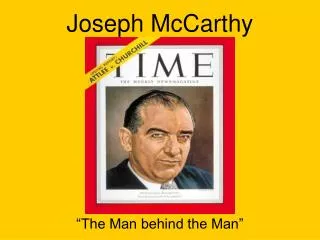
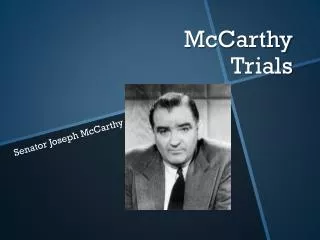
Senator McCarthy • A senator from Wisconsin • He accused hundreds of politician, writers, directors, entertainers, and homosexuals of communist affiliation • Made it clear to witnesses that the only way to show allegiance to U.S. was to name names of others in the communist party • His trials were highly publicized and ruined many careers
The House of Un-American Activities Committee (HUAC) • The objective was to undermine the American communist party • Established in 1938 by congress under Martin Dies to investigate unpatriotic behavior • In 1947 J. Parnell Thomas began an investigation into the Hollywood Motion Picture Association
“Friendly Witnesses” • The HUAC interviewed 41 people who were working in Hollywood. • These people attended voluntarily and became known as "friendly witnesses". • During their interviews they named nineteen people who they accused of holding left-wing views. • Ten of these nineteen people refused to name names to save themselves. They became known as the “Hollywood Ten”
The Red Channels • June 1950: a pamphlet listing 151 names of writers, directors, and actors who were alleged communists • These people were blacklisted until they were cleared by HUAC • Anyone who refused to name names for HUAC was blacklisted by Hollywood studios
Arthur Miller • Used his personal moral and political convictions to write over 30 stage plays and screen plays • Won a Pulitzer prize for his outstanding efforts • Was convicted of contempt of congress for not naming names to HUAC • Conviction was overturned a year later
The Crucible • ." The Crucible, which premiered in 1953, is a fictionalization of the Salem witch-hunts of 1692, but it also deals in an allegorical manner with the House Un-American Activities Committee.