Studying Aqueous Hybrid Batteries
10 likes | 145 Vues
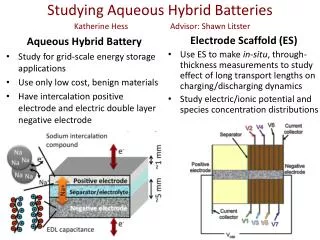
This research focuses on the examination of Aqueous Hybrid Batteries using an Electrode Scaffold (ES) to conduct in-situ, through-thickness measurements. The study aims to investigate the effects of long transport lengths on charging and discharging dynamics by analyzing electric and ionic potential distributions as well as species concentration profiles. Designed for grid-scale energy storage, this research emphasizes the use of low-cost, benign materials and explores an intercalation positive electrode coupled with an electric double layer negative electrode, pushing forward sustainable energy solutions.


Studying Aqueous Hybrid Batteries
E N D
Presentation Transcript
Studying Aqueous Hybrid Batteries Katherine Hess Advisor: Shawn Litster Electrode Scaffold (ES) • Use ES to make in-situ, through-thickness measurements to study effect of long transport lengths on charging/discharging dynamics • Study electric/ionic potential and species concentration distributions Aqueous Hybrid Battery • Study for grid-scale energy storage applications • Use only low cost, benign materials • Have intercalation positive electrode and electric double layer negative electrode