Understanding Imperialism in Africa: Expansion and Resources (1880-1900)
This text explores the phenomenon of imperialism, specifically focusing on the late 19th century when nearly all of Africa fell under European colonial rule. It examines the motivations behind imperialism, key locations such as the Suez Canal and South Africa, and the resources exploited by colonial powers, including peanuts, timber, and gold. The text also covers notable historical figures like Muhammad Ali of Egypt and the Zulus in South Africa, shedding light on the resistance movements and the vast network of railroads developed during this period.

Understanding Imperialism in Africa: Expansion and Resources (1880-1900)
E N D
Presentation Transcript
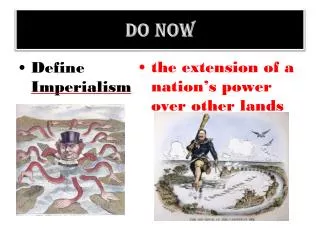
Do Now • the extension of a nation’s power over other lands • Define Imperialism
Drawing the African Map What do you notice about railroad development in Africa? Look at how far and where it takes place – Compare it to your Resource List
Imperialism in Africa By 1900, almost all Africa is under European rule, • Between 1880 and 1900, nearly all of Africa comes under European powers • Only Liberia and Ethiopia remain free as paternalistic nations exploit valuable resources • Key African resources: peanuts, timber, hides, minerals, gold, diamonds • Key locations: Suez Canal, South Africa and successfully stop any African resistance. • Muhammad Ali & Egypt • Zulus in South Africa c. Muhammad Ahmad in Sudan
“Dr. Livingstone, I presume?” Answers to WS Page 55 • No – All south of Equator. • Nyasa & Tanganyika • First Expedition – went to Comoro Islands • Zambezi River • Approx. 4,000 mi • First Expedition – Port Elizabeth, Luanda, Comoro Islands • Rain, wind, heat, mud, fever, malaria, vomiting, mutiny, lions • To Christianize, for Commerce, & to Civilize