Understanding Adolescence and Cognitive Development
Explore the transition from childhood to adulthood, cognitive development stages, puberty, and adolescence characteristics. Delve into the complexities and challenges faced during the teen years.

Understanding Adolescence and Cognitive Development
E N D
Presentation Transcript
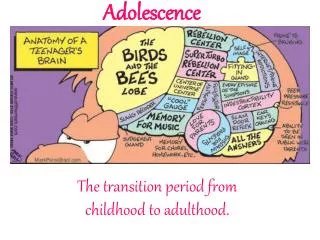
Definition: The transition from childhood to adulthood. • Time for formulating personal identity. • Time for gaining emancipation from family unit. • Generally (and flexibly) regarded as ages 11-19. • (Some persons function as adolescents well into the 20s or later). • Time for driving moms and/or dads crazy!
Puberty-a stage of adolescence • Beginning of physical transition from childhood to adulthood. • Reproduction becomes possible (internal phenomena). • Not noticeable externally.
Cognitive Development Concrete Operations (ages 7-11) • Child able to solve new problems related to immediate present world. • Reasons inductively (based on the influence of others). • Cannot yet reason by deduction or by hypothetical reasoning.
Cognitive Development Formal Operations (ages 12-15) • Child develops hypothetical reasoning. • Problems are attacked from all angles and multiple solutions are considered. • Can systematically isolate variables and can think introspectively
Evidence of Capacity for Formal Operations: • Can manipulate two or more variables simultaneously • Can hypothesize about logical consequences of events • Can foresee the consequences of personal actions • Can detect the logical consistency within a statement • Can think realistically about self, others, and their world • Can think without egocentrism (thinks about the whole and not the self)
Developmental Changes • 1. Rapid growth (early in adolescence) • 2. Confused by changes • 3. Curious about final outcome of changes • 4. Rebellion against home/parents • 5. Vacillation between considerable maturity and babyishness • 6. Absorption with close friend(s) of same age and sex • 7. Moodiness, sloppiness, and disorder • 8. Establishing independent self: .Who am I?. .What kind of person am I?. • 9. Acute body-consciousness • 10. Appearance of sexual maturity • 11. Skin problems
Early Adolescence-Puberty (ages 11.13) • 1. Constantly hungry (noticeable increase) • 2. Enjoy companionship at meals and at after-school snacks • 3. Sleep more than previously • 4. Sleepy at .getting up. times • 5. Want to stay up late as a sign of increasing maturity
Special Characteristics of Boys • 1. Boisterous • 2. Clumsy • 3. Secretive, uncommunicative at home • 4. Aggressive • 5. Dirty-poor personal hygiene • 6. Gain more weight and height than do girls in puberty • 7. Much talk about sex and girls • 8. More interested in companions and activities outside the home
Special Characteristics of Girls • 1. Vague and scattered • 2. Have crushes on older men • 3. Interested in romantic love • 4. Engage in playacting • 5. Talkative, but not communicative • 6. Giggly!
Middle Adolescence (ages 14-16) Experimentation • 1. Drinking, drugs, smoking, and sexual experimentation are often of the highest interest • 2. Possible first intercourse or first pregnancy occurs
Middle Adolescence (ages 14-16) Risk-Taking • 1. Have little concept of cause and effect • 2. Perceived omnipotence and invulnerability are the rule • 3. Unable to link drinking with auto accidents, pregnancy, or STDs
Middle Adolescence (ages 14-16) Striving for Independence • 1. Strong need to strive for independence and autonomy • 2. Frequent conflicts with parents need confrontation and resolution • 3. Parental conflicts are normal and necessary • 4. Confide in other adolescents
Sexual Development Sexuality is a major preoccupation. Experience unpredictable surges in sexualdrive-accompanied by unavoidable sexual fantasies and impulses.
Boys more sexually active than girls because: • Females less likely to discover sexual responses spontaneously because their sexual organs are less prominent and subject to manipulation • Testosterone increases are much more abundant in boys • High male testosterone may result in greater aggressiveness and more purely physical drives for gratification • Girls tend to view sexual gratification as secondary to fulfillment of other needs, e.g., love, affection, self-esteem, and reassurance • Girls, thus, are less likely to abstain from sex in relationship
Motivation to participate in sexual activity arises from need to: • Gratify true sexual impulses • Gratify nonsexual needs (achieve sense of closeness to someone, bolster self-esteem, to consolidate gender identity, or to act out against authority)
Late Adolescence (ages 17-19) Characteristics of Both Sexes • 1. Rebellious • 2. Concerned with personal appearance • 3. Moody • 4. Interested in opposite sex • 5. Ego identity established..Where do I fit into the world?. • 6. Growth subsides; full stature nearly attained • 7. Sleep and food requirements approach adult level • 8. Prefer companionship when eating • 9. Intimate relationship with buddy fades • 10. Greater interest in opposite sex • 11. Need acceptance by society, in job, and in college • 12. Need parental respect for opinion and acceptance of maturity
Special Characteristics of Boys • 1. Sexual problems prominent and demanding • 2. Interested in career planning • 3. Less interested than girls in mate seeking Special Characteristics of Girls • 1. Interest in boys now directed toward mate seeking • 2. Absorbed in fantasies of romantic love • 3. Less interested than boys in career planning • 4. Sexual problems less demanding than in boys
Communication Barriers • Commonly distrust adults and authority figures • Question whether adults actually listen to them or understand their feelings • Limit communication to avoid revealing their vulnerabilities • Typically fearful of adults asking questions • Intent upon preserving their privacy • Wish to be treated with respect and trust as young adults • Distrust parental involvement, as they fear punitive consequences may result