Challenges and Strategies in Beach Nourishment: A Global Perspective
This article explores the multifaceted issues surrounding beach nourishment, focusing on locations like Miami Beach, Cesme, and Durban. It examines problems such as poor sand quality, sourcing issues, costs, and overdevelopment. The advantages and disadvantages of beach nourishment are discussed, including its role in responding to sea-level rise, shoreline preservation, and the economic impacts. Case studies from New Jersey and Maldives highlight the global implications of coastal management. The discussion emphasizes sustainable practices and the necessity for adaptation in a changing environment.

Challenges and Strategies in Beach Nourishment: A Global Perspective
E N D
Presentation Transcript
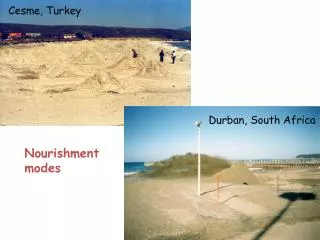
Cesme, Turkey Durban, South Africa Nourishment modes
Problems with Beach Nourishment • Bad sand • Sand source • Costs - who pays? • Promotes overdevelopment • Meaningless design • Environmental destruction
Relocation / Retreat • Advantages • Responds to sea-level rise • Preserves the beach • Saves shoreline stabilization costs • Preserves Buildings • Disadvantages • Politically difficult • Potentially costly • Loss of land
“Paradise almost lost: Maldives seek to buy a new homeland” “The last days of paradise The president of the Maldives wants to buy a new home for all 300,000 of his people... “ November 2008
Retreat March 2008
“If a clod be washed away by the sea, Europe is the less, as well as if a promontory were” John Donne (1572-1631), from Devotions Upon Emergent Occasions, Meditation XVII.
Beach Nourishment Schemes Spain and Italy Hanson et al. (2002) Coastal Engineering
Geoscience – understanding the coastal system • Defining Relative Sea level (past and future) • Understanding Ice-Earth-Ocean interaction • Coastal Response to RSL (and other) forcing Environment and Society • Adaptation • Sustainable shorelines