Understanding the Scientific Method in Biology: A Guide to Experimentation
This guide introduces the scientific method as a crucial framework in biology, detailing each step from observation to conclusion. It emphasizes the importance of distinguishing between qualitative and quantitative observations and forming hypotheses based on natural wonders. Learn how to design controlled experiments, collect and analyze data, and evaluate results. Whether you're studying how owls hunt at night or exploring other biological phenomena, mastering this method will enhance your scientific inquiry and research skills.

Understanding the Scientific Method in Biology: A Guide to Experimentation
E N D
Presentation Transcript
Intro to Scientific Method Biology CPA
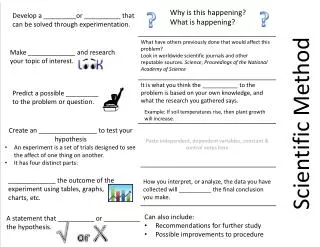
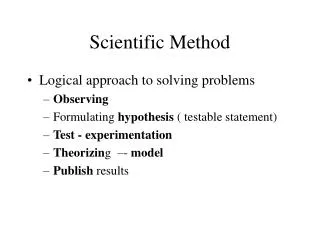
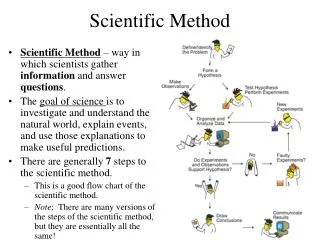
Designing and Experiment • Scientific Method • Observation • Question • Form a hypothesis • Experiment • Data collection and analysis • Conclusion
Observation and Question • Begins with observing something in nature • 2 types of observation • Qualitative – using senses • Quantitative – measurement • Wondering how or what about it • Ex: • Observation: Owls capture prey in the dark • Question: How do owls detect prey in the dark?
Hypothesis • Possible answers for question in mind that you can test with an experiment • Educated guess of how something occurs • Can be more than one • Ex: • Owls hunt in the dark by vision • Owls hunt in the dark by hearing • Owls hunt in the dark by sensing body heat
Experiment • Design an experiment to test your hypothesis • Controlled experiment • Control group • What you compare data to • Experimental group • What you are testing for • Independent variable • What is being tested for (ex: presence or absence of light) • Dependent variable • How the experiment responds (ex: if the owl can catch its prey)
Collecting/Analyzing Data • Collecting Data • Usually quantitative data • Compare experimental results to controlled results • Analyzing Data • Compare results to other studies and refine hypothesis • Create charts, graphs, tables to show data
Conclusion • Either supports or rejects your original hypothesis • If it supports • Can move on to construct a theory with research • If it rejects • Refine and change hypothesis and create new experiment