Download
1 / 27
270 likes | 410 Vues
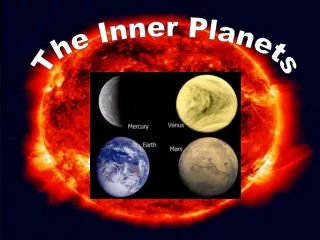
Dive into the fascinating characteristics of Mercury, Venus, and Mars, the inner planets of our solar system. Mercury, with its weak gravitational force and extreme temperatures, features numerous craters and evidence of tectonic activity. Venus, Earth's twin, is shrouded in sulfuric acid clouds, exhibiting extreme surface temperatures due to a potent greenhouse effect. Mars, the "Red Planet," showcases Earth-like traits, including seasonal changes and geological features such as canyons and volcanoes, as well as its thin carbon dioxide-rich atmosphere. ###

E N D
Small • Weak gravitational force • No atmosphere • Many craters
Caloris Basin - one giant crater (1000 miles in diameter) • Many cliffs and peaks evidence of tectonic activity • Mean surface temp 442.5 K, ranges from 100 K to 700 K
http://solarsystem.nasa.gov/multimedia/videos/Keplers_Laws_fullscreen.movhttp://solarsystem.nasa.gov/multimedia/videos/Keplers_Laws_fullscreen.mov
Venus Earth’s sister planet
Covered with an opaque layer of highly reflective clouds of sulfuric acid • Surface temperatures high enough to melt lead.
After the Moon, it is the brightest natural object in the night sky
Orbits every 224.7 Earth days • Rotation is slow and retrograde, 243-day period • Time from one sunrise to the next is 117 Earth days
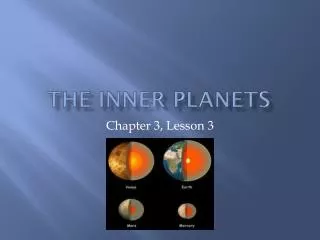
Radius is 95% of Earth's, and the density similar to Earth's, 80% • Liquid metal core similar to the Earth's
Atmosphere • Thick, high pressure (90 atm) • Density 50 times greater than on Earth! • Made of CO2, N, with sulfuric acid clouds • Strong greenhouse effect
Surface • 450°C (850°F) hot!! everywhere, always, including night time • Dry, dusty rocks, no water • May have had water in the past • Orange light, (atmosphere reflects mostly blue light)
most ``earthlike'' • 1/2 size of Earth • 24h 37m day • thin atmosphere of 95% CO2 • much colder than Earth -- 187o K to 244o K (-123o F to -20o F ) • atmospheric pressure 0.7% of Earth's (equivalent to 100,000 ft altitude on Earth)
tilted 25o ---> seasons • dust storms originally thought to be bands of vegetation ad irrigation canals built by Martians!
http://www.disclose.tv/action/viewvideo/16067/Orson_Welles__War_Of_The_Worlds_Pt_2_7/http://www.disclose.tv/action/viewvideo/16067/Orson_Welles__War_Of_The_Worlds_Pt_2_7/
clouds, sediment layers, canyons, landslides, sand dunes, enormous young volcanos as tall as 78,000 ft (flyby 1 and flyby 2)
dry riverbeds (in older regions), evidence that liquid water once flowed • no water in liquid state now, all water frozen in ice caps/permafrost
The "Red Planet” iron oxide • Two moons, Phobos Deimos
Atmosphere • Carbon dioxide 95.32% • Nitrogen 2.7% • Argon 1.6% • Oxygen 0.13%
First fly-by • Mariner 3 (1965)
http://www.hulu.com/watch/63307/cosmos-blues-for-a-red-planethttp://www.hulu.com/watch/63307/cosmos-blues-for-a-red-planet