Understanding Profit, Debt, and Equity in Business Financing
Starting a firm requires significant capital for fixed costs like plant, equipment, and product development. Funds can be raised through debt (borrowing at a fixed interest rate) or equity (selling shares). Opportunity cost plays a crucial role in assessing true economic profit, which is revenue minus all costs, including the opportunity costs of resources and labor. Understanding the difference between earnings and economic profit is vital for evaluating financial success, especially when facing bankruptcy, where a firm may negotiate debt repayments to ensure survival.

Understanding Profit, Debt, and Equity in Business Financing
E N D
Presentation Transcript
Debt and Equity • To start a firm requires $ for plant, equipment, product development, etc • Those $ will be part (or all) of fixed costs • Can raise the $ two ways: • Borrow at fixed rate of interest– Debt • Sell shares in the firm - Equity
Opportunity Cost • The value of the item in the best use (other than this one.) • Value of my grandma’s building if not used for my Dad’s company • Value of my Dad’s time if not used for his company • Value of the money invested in the business if it were used in another business instead.
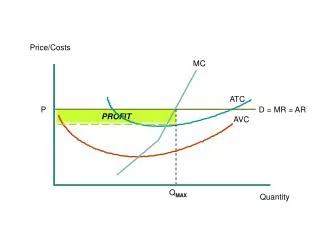
Profit and Earnings • Economic profit: Revenue – All costs • Cost Includes: • all of the money that went in to the firm, whether debt or equity • Opportunity cost of entrepreneurs’ labor, real estate etc. • Earnings: Revenue – VC – debt service • Doesn’t acct for • Opportunity cost • Value of invested capital (what people paid for shares.)
Businessman and Economist • Business: I got earnings of $100K on my $1M investment. I earned 10 percent! • Economist: He earned the same 10 percent on his money that he would have earned if he just invested in the stock market. • So: Earnings – Opportunity Cost of Capital = ZERO • His profits were ZERO. • (Just terminology, but important.)
Bankruptcy • Earnings < 0 • Lets assume no self supplied labor, buildings,etc • Same as Revenues – VC – debt service < 0 • Same as R – VC – debt – opp. Cost capital < - opp. Cost of capital • Same as Profit < Opp. Cost of Capital • Can’t pay bank loans and VC of production.
Point of Bankruptcy • Legal mechanism • Allows firm to negotiate with suppliers and pay back less than all its debt so that it can survive. • Makes sense when can pay back some, but not all of debt. • Makes sense when firm will make more money alive than dead