The Importance of Lifelong Learning in a Changing World: Addressing Inequalities and Advancements
70 likes | 202 Vues
Lifelong learning (LLL) is crucial for adapting to demographic changes, economic competitiveness, social inclusion, and personal development. With the aging population, migration patterns, and the demand for skilled labor, LLL serves as a public good that promotes employability and social cohesion. However, barriers such as the digital divide and participation gaps highlight the need for effective policies and local initiatives. By coordinating efforts among government, private sectors, and civil society, we can create an inclusive framework that motivates learners and fosters collaboration, ultimately transforming inequities into opportunities for growth.


The Importance of Lifelong Learning in a Changing World: Addressing Inequalities and Advancements
E N D
Presentation Transcript
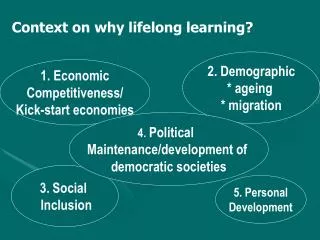
Context on why lifelong learning? 2. Demographic * ageing * migration 1. Economic Competitiveness/ Kick-start economies 4. Political Maintenance/development of democratic societies 3.Social Inclusion 5. Personal Development
Spectrum of State Involvement Mixed model ‘Public service’ model LLL as ‘public good’ Strong involvement of state ‘Market’/’quasi-market’ model LLL as ‘private good’ Minimal involvement of state Mixed model Position dictated by: History and/or Ideology and/or Resources
Gaps in participation • ‘Matthew effect 1’ - volume & distribution - a ‘double-edged sword’? • Adults with high level of education are > 6 times > likely to participate than low skilled • Age - persons aged 55-64 participate 4 times less (4.6%) than persons aged 25-34 years (15.5%) • 61% of aged 55+ have never used a computer
Policy Goals - Tensions • Economic, social and/or cultural policy?? • Government/Social movement/private sector • Learning for a living : learning for living • Employability /Social cohesion • More & better jobs : better social cohesion • A public good : a private good • Government responsibility/learner agency • Political control : market control • Knowledge economy : knowledge society • Contexts: Globalization/decentralization
LLL in the 21ST CENTURY Needs to address a wide range of divides, e.g; • knowledge divide; skills divide • digital divide; gender divide (e.g. ethnic minorities); age divide A social inclusion and equality framework serving multiple purposes, viz., • compensatory (recompense for learning not achieved) • educational (prepares for next level) • economic (the labour market) • redistributive (access to qualifications) • promotion of equality (between sectors) • inter-generational
Challenges 1. Vision/Reality of poverty >Ensuring a holistic perspective (with political , cultural , financial and technical dimensions)that transforms inequities 2. Policy discourse/implementation • How to organize/manage LLL in the context of decentralization • Coordinating different govt agencies • Bringing LLL closer to the people who need them most • Strengthening local initiatives
Challenges 3. Synergies/fragmentation • Formal/non-formal • RVA of prior learning 4. Partnership /Competition >The complexity of providing LLL opportunities requires active involvement of social partners & civil society >Building networks of providers and learners 5. Motivating learners/creativity and autonomy