Download
1 / 19
190 likes | 306 Vues
This resource covers essential concepts from calculus, focusing on the Mean Value Theorem (MVT) and its implications. It explains the conditions under which MVT applies, the physical interpretation related to speed, and introduces Rolle’s Theorem as a special case. The material also touches on function behavior, including local extrema, intervals of increase and decrease, and the concept of antiderivatives. It includes example problems and assignments for practice, specifically targeting sections 4.2 and 4.3 from the textbook, ensuring comprehensive understanding.

E N D
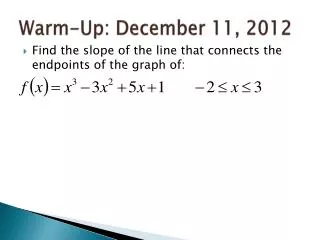
Warm-Up: December 11, 2012 • Find the slope of the line that connects the endpoints of the graph of:
Mean Value Theorem Section 4.2
Mean Value Theorem • If y=f(x) is continuous at every point of the closed interval [a, b] and differentiable at every point of its interior (a, b), then there is at least one point c in (a, b) at which
One Physical Interpretation – Speed • The instantaneous speed at some interior point must equal the average speed over the entire interval. • If a car’s average speed for a trip is 30 mph, then its speedometer must have read 30 mph at some point during the trip.
Rolle’s Theorem • Special case of the Mean Value Theorem
Increasing and Decreasing • Let f be a function defined on an interval I and let x1 and x2 be any two points in I. • A function is called monotonic if it is increasing everywhere inside an interval or if it is decreasing everywhere inside an interval
Increasing and Decreasing • Let f be continuous on [a, b] and differentiable on (a, b).
Example 1 • Find: • The local extrema • The intervals on which the function is increasing • The intervals on which the function is decreasing
Assignment • Read Section 4.2 (pages 186-191) • Page 192 #1-19 odd • Page 192 #25-41 odd • Read Section 4.3 (pages 194-203)
Warm-Up: December 12, 2012 • Find: • The local extrema • The intervals on which the function is increasing • The intervals on which the function is decreasing
Consequences of the MVT • If f’(x)=0 for all x, then there is a constant C such that f(x)=C for all x. • If f’(x)=g’(x) for all x, then there is a constant C such that f(x)=g(x)+C
Antiderivative • A function F(x) is an antiderivative of f(x) if F’(x)=f(x). • The process of finding an antiderivative is antidifferentiation. • There are an infinite number of antiderivatives of any given function, that only differ by a constant, C. Differentiation Antidifferentiation
Example 2 • Find all possible functions f with the given derivative.
Example 3 • Find the function with the given derivative whose graph passes through the point P.
You-Try #3 • Find the function with the given derivative whose graph passes through the point P.
Assignment • Read Section 4.2 (pages 186-191) • Page 192 #1-19 odd • Page 192 #25-41 odd • Read Section 4.3 (pages 194-203)