Understanding Congruence in Triangles and Their Correspondence**
80 likes | 215 Vues
This lesson explores the concept of congruence in triangles, detailing how corresponding angles and sides are congruent between two figures. It introduces the Third Angles Theorem, stating that if two angles in one triangle are congruent to two angles in another, the third angles must also be congruent. Key properties of congruent triangles, such as reflexive, symmetric, and transitive properties, are discussed. Practical examples illustrate how to identify congruent triangles and apply these principles.


Understanding Congruence in Triangles and Their Correspondence**
E N D
Presentation Transcript
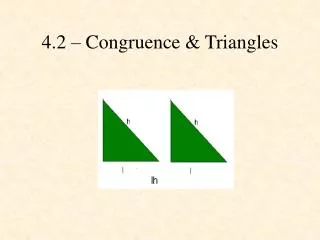
Correspondence • When two figures are congruent, their corresponding angles and corresponding sides are congruent
Third Angles Theorem • If two angles of one triangle are congruent to two angles of another triangle, then the third angles are congruent.
Properties of Congruent Triangles • Reflexive – every triangle is congruent to itself. • Symmetric – if ABC DEF, then DEF ABC. • Transitive - if ABC DEF and DEF GHI, then ABC GHI
Example 1 • If ABC DEF, what is A and C? • Solution: • C = F (Corresponding) • C = 40 • A = 180 – 140 • A = 40
Example 2 • Can these triangles be proven congruent • Yes – All the corresponding angles and sides are congruent • Congruence Statement: ABC DEF
Assignment • P. 205 4-21all, 24-29all