
Hematopoiesis and Anemia: A Comprehensive Guide
E N D
Presentation Transcript
Hematopoiesis • Fetus: liver, spleen, bones sometimes regain heatopoietic activity in the adult: i.e. myelofibrosis • Child: long bones, skull, vertebrae etc. • Adult: vertebrae, sternum, ribs, pelvic bones and long bones, skull - about 1 kg tissue producing 1011 cells/day
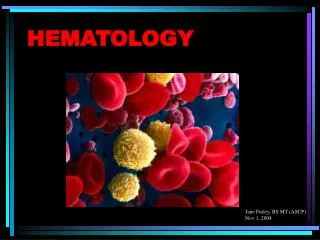
Hematopoietic cells • Pluripotent stem cell compartment • relatively small, lymphocyte-like cells • Proliferating cells of committed lineage myeloid, erythroid, megakaryocyte, lymphoid, reticulum cell lines • Maturing (postmitotic) cells • Mature cells circulating half life: pmn.leukocytes 6 hours platelets: 8-10 days erythroid cells: 120 days
Erythropoiesis • Stimulus: hypoxia erythropoietin (in the kidney [and liver]) pluripotent stem cells CFU-E BFU-E proerythroblasts erythroblasts normoblasts mature red blood cells
Leukocyte production • Pluripotent stem cells • Myeloblasts • Promyelocytes • Myelocytes
Leukocyte production Metamyelocyte
Leukocyteproduction Band-form
Leukocyte production Mature polymorphonuclear granulocyte
Megakaryocyte line Giant, multinucleated cells Breaks up, releasing about 5000 platelets
Marrow lymphocytes arising also in spleen and lymph nodes lifetime: years
Bone marrow function • Hematopoiesis • Antibody producing plasma cell differentiation • Monitoring hematopoietic cell quality • Important key nutrients: iron folic acid vitamin B12 regulatory hormones (EPO, CSF-s) interleukins
Anemia • Decrease in red cell mass or hemoglobin content of blood below the physiologic need • Not a disease itself! A clinical sign! • Analysis of anaemia • seek the background mechanisms • loss of red blood cell - bleeding • lack of red blood cell production • excessive red blood cell damage
History • Family history: anemia, splenomegaly, jaundice • Bleeding tendency in the family • Diet, alcohol intake • Menorrhagia • Drugs • Chronic diseases • Malnutrition, malabsorption • Transfusion, iron or other therapy against anemia
Anemia • Signs and symptoms vary with the rapidity of onset: • Rapid (bleeding or brisk hemolysis) • cardiovascular compensatory reactions: tachycardia, postural hypotension, vasoconstriction in the skin and extremities, dyspnea on exertion, faintness, even shock • Slowly developing anemias (ie.nutritional deficiency, chr.bleeding, hemolysis etc.) • there is time for compensation • the patient remains asymptomatic for a long time
Anemia • Mild: often asymptomatic • Moderate: symptoms on exertion • Severe: symptoms on rest heart failure
Anemia - physical findings Non cause-specific • Pallor of skin and mucous membranes • causes: Hb and blood redistribution from the skin • colors • greyish: malignancy • lemon-like: hemolysis, B12 deficiency • Tachycardia • Hyperkinetic precordium • Systolic murmur (reversible)
Anemia - physical findings Cause-related • Jaundice hemolysis • Hepatosplenomegaly - e.g.hemolysis • Lymphadenopathy - lymphomas, autoimmune diseases • Cheilosis (fissura)iron deficiency • Koilonychia (spoon-shaped nails) iron def. • Beefy red smooth tongue (Hunter-glossitis) - pernicious anemia • Neuropathy - pernicious anemia • Rectal digital examination - bleeding
Laboratory evaluation of anemia • Complete blood picture • Red cell indices • red blood cell count F:3,9-5,6, M:4,5-6,5 G/l • hemoglobin level F:115-155 M:135-175 g/l • hematocrit F:36-48 M:40-52% • MCV: mean corpuscular volume 80-95 fl • MCH mean corpuscular hemoglobin 27-34 pg • MCHC: mean corpuscular hemoglobin concentration 300-350 g/l • Reticulocyte count (traces of endoplasmic reticulum) - good marker of erythropoiesis 0,5-1,5%
MCV • Microcytic anemia (MCV<80 fl) iron deficiency, thalassemia, sideroblastic anemia • Normocytic anemia (MCV 80-100 fl) acute bleeding, renal failure, aplastic anemia • Macrocytic anemia (MCV>100 fl) vitamin B12, folic acid deficiency, liver disease, alcoholism, hypothyroidism
MCH • Hypochromic (MCH<27 pg) • Iron deficiency(i.e. chr. bleeding, malabsorption) • chr. inflammation, malignancy, chr. infection, thalassemias, myelodysplastic sy. • Normochromic (MCH 27-34 pg) • acute bleeding, hemolysis, aplastic anemia, renal anemia • Hyperchromic (MCH>34 pg) • megaloblastic anemia (B12, folic acid deficiency)
Clinical classification of anemias • Decreased cell production • Aplastic anemia • Myelodysplastic syndrome • Deficiency anemias (iron, B12, folic acid) • Erythropoietin deficiency (renal failure) • Bone marrow suppression (malignancy, toxin,virus) • Increased red blood cell destruction/elimination • Extrinsic factors (immun, toxins, mechanic) • Membrane defects • Enzyme defects • Hemoglobinopathy • Blood loss (genitourinary, gastrointestinal, pulmonary other bleeding)
Bone marrow investigationBone marrow biopsy or aspiration • bone marrow cellularity • myeloid-erythroid ratio (norm: 2-3:1) • cell maturation • bone marrow infiltration • stromal cells (fibroblasts etc.)
Polycythemias • Hyperviscosity • Decreased cerebral blood flow tinnitus, lightheadedness, dizziness, stroke • Congestive heart failure • Thrombosis • Increased cell turnover • Gout (due to hyperuricemia) • Itching • In polycythemia vera • Thrombocytosis • Hemorrhage
Polycythemias • Primary: polycythemia vera myeloproliferative disorder • other cell lines are affected (leukocytosis, thrombocytosis) • hepatosplenomegaly • EPO level: low • Secondary: • hypoxia EPO production • chr. pulmonary diseases • morbid obesitiy (Pickwick’s syndrome) • high altitude • EPO overproduction: tumors
Leukocyte disorders 1. Benign alterations 2. Malignant diseases
Neutrophil granulocytes • Functions: • chemotaxis • phagocytosis • microbial killing • Disorders • neutropenia, agranulocytosis: abs.count<1000 causes:drugs, autoimmun diseases, viral infections (e.g. EBV,HIV,hepatitis), B12 deficiency, leukemias,alcoholism increased risk of infection • neutrophilia:infections, stress, drugs (steroids) • left shift: bacterial infections
Mononuclear phagocytesmonoblasts, promonocytes, monocytes, tissue macrophages • Functions • chemotaxis • ingestion and killing microorganisms • secretion of several factors proteases, cytokines, reactive oxygen compounds, colony stimulating factors • interaction with lymphocytes • antigen processing and presentation
Eosinophil granulocytes • Eosinophilia: • Parasitic infections • Allergies • Autoimmune diseases • Hematologic malignancies (CML, Hodgkin’s disease etc.)
Basophil granulocytes • Important role in: • inflammation • hypersensitivity reactions • Basophilia: malignant hematologic diseases
Acute leukemias • Agressive immature hemopoietic cell proliferation, without differentiation (hiatus leucemicus in the blood smear) • Subtypes: • ALL (acute lymphoblastic leukemia) • ANLL (acute non lymphoblastic leukemia) or AML (acute myeloblastic leukemia)
Acute leukemia syndrome • Susceptibility to infections - serious infections • Anemia due to bone marrow infiltration and bleeding • Thrombocytopenia - bleeding tendency purpuras, petechiae, mucosal bleeding • Organ infiltration