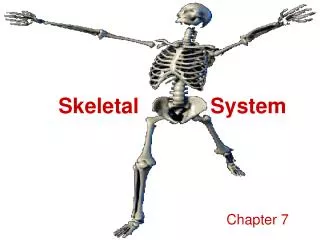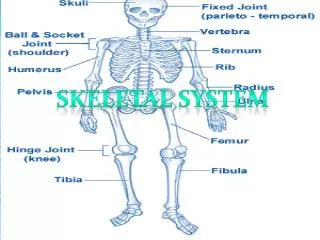
Skeletal System
This overview delves into the structural organization of the skeletal system, highlighting the axial skeleton (80 bones) and appendicular skeleton (126 bones). We explore critical aspects of endochondral ossification, including diaphysis, epiphysis, and metaphysis. The document discusses various congenital and hereditary diseases, such as Osteogenesis Imperfecta and Achondroplasia, as well as inflammatory conditions like Rheumatoid Arthritis and Osteoarthritis. Imaging methods like MRI and CT are also covered, demonstrating their role in diagnosing skeletal diseases and conditions.


Skeletal System
E N D
Presentation Transcript
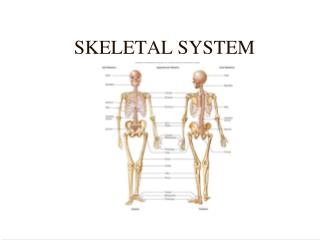
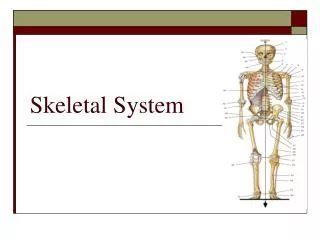
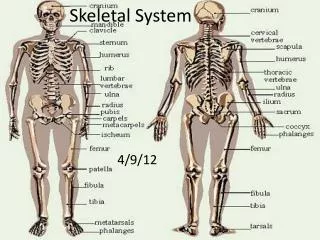
Axial Skeleton • 80 bones
Appendicular Skeleton • 126 bones
Endochondral Ossification Diaphysis: refers to the shaft portion of the long bones. Primary site of ossification. Epiphysis: expanded end portion and it’s the secondary site of ossification. Metaphysis: growth zone between the epiphysis and diaphysis.
Osteogenesis Imperfecta • Often called brittle bone disease • Hereditary or congenital • Serious disease • Bone cortex is thin and porous, and trabeculae are thin, delicate and widely separated • X-ray demonstrates various fractures in various stages of healing and general decrease in bone mass
Achondroplasia • Most common inherited disorder of the skeletal system • Results in bone deformity & dwarfism • Normal trunk size & shortened extremities • Usually no more than 4ft tall • Clinical manifestation: • Lumbar lordosis, • bowed legs, • bulky forehead with hypoplasia • narrowing of foramen magnum causing neural compression
Osteopetrosis • Bones are abnormally heavy and compact but brittle • All bones are affected by most changes occur in long bones of extremities, vertebrae, pelvis and base of skull • X-rays demonstrate increase in thickness and density of bony cortex. • Increase in the # and size of trabeculae, reduction of the marrow space
Scoliosis • Lateral curvature of the spine • Does not usually become visible until adolescents • Affects girl more
Transitional VertebraOften called Lumbar Ribs • Takes on characteristics of both vertebrae on each side of a major division of the spine • 1st lumbar may have a rib • At C7 there may be a cervical rib
Anencephaly • Congenital abnormality • Brain and cranial vault do not form • Results in death shortly after birth • Can be diagnosed with US before they are born
Rheumatoid Arthritis • Chronic autoimmune that may fluctuate in severity • Overgrowth of the synovial tissues • X-ray shows soft tissue swelling & osteoporosis of affected bone. Bone erosion & decalcification
Osteoarthritis • Most common form of arthritis • Articular cartilage degenerates & gradually is worn away exposing underlying bone • Ostephytes & bone spurs are on x-rays
Osteomyelitis • Infection of the bone & bone marrow • Symptoms & signs include fever, heat in the affected area, & dull pain • X-rays demonstrate loss of bone calcium and soft tissue swelling
Ankylosing Spondylitis • Progressive form of arthritis affecting the spine • X-ray shows bilateral narrowing & fuzziness of the SI joints • Calcification of the bones of the spine with ossification of the vertebral ligaments
Gout • Is an inherited metabolic disorder in which excessive amounts of uric acid is produced & deposited in the joint and adjacent bone • Bone changes include erosion & overhanging edges
Spondylolisthesis • Slipping of the body of the vertebra • Symptoms are similar to those of a herniated disk
Osteochondroma • Benign bone tumor • Affects women more than men • Asymptomatic • Excessive bone growth • Cortex of osteochondroma blends in with normal bone and growth protrudes up & away from nearest joint
Osteosarcoma • Most common primary malignancy of the skeleton • Highly aggressive and most often occurs in the bone marrow • X-ray appears as a sunray or sunburst
Bone Cyst • Idiopathitic disease and is not a true neoplasm • Consists of numerous blood filled arterivenous communications • Most common treatment is surgical removal
MRI • Superior contrast resolution for soft tissue detail • Modality of choice for soft tissue tumor • Extremely useful in eval of joints • MRi detects a larger number of musculoskeletal subtleties with higher resolution imaging • Bone marrow imaging is better than nuc med scans for subtle abnormalities
CT • Can be performed quickly & noninvasively • Defines extent of fractures and dislocations • Superior to MRI for cortical bone and visualization of bony detail • Gives better bone detail than plain x-ray • Has been largely replaced by MRI for soft tissue
Nuclear Medicine • Has advantage over CT & MRI because it can scan the whole body at one time • Can show if an injury is old or new • Still the standard for examination of metastatic processes because it demonstrates metabolic reaction of bone to the disease process • Is more sensitive than comparative radiographic studies